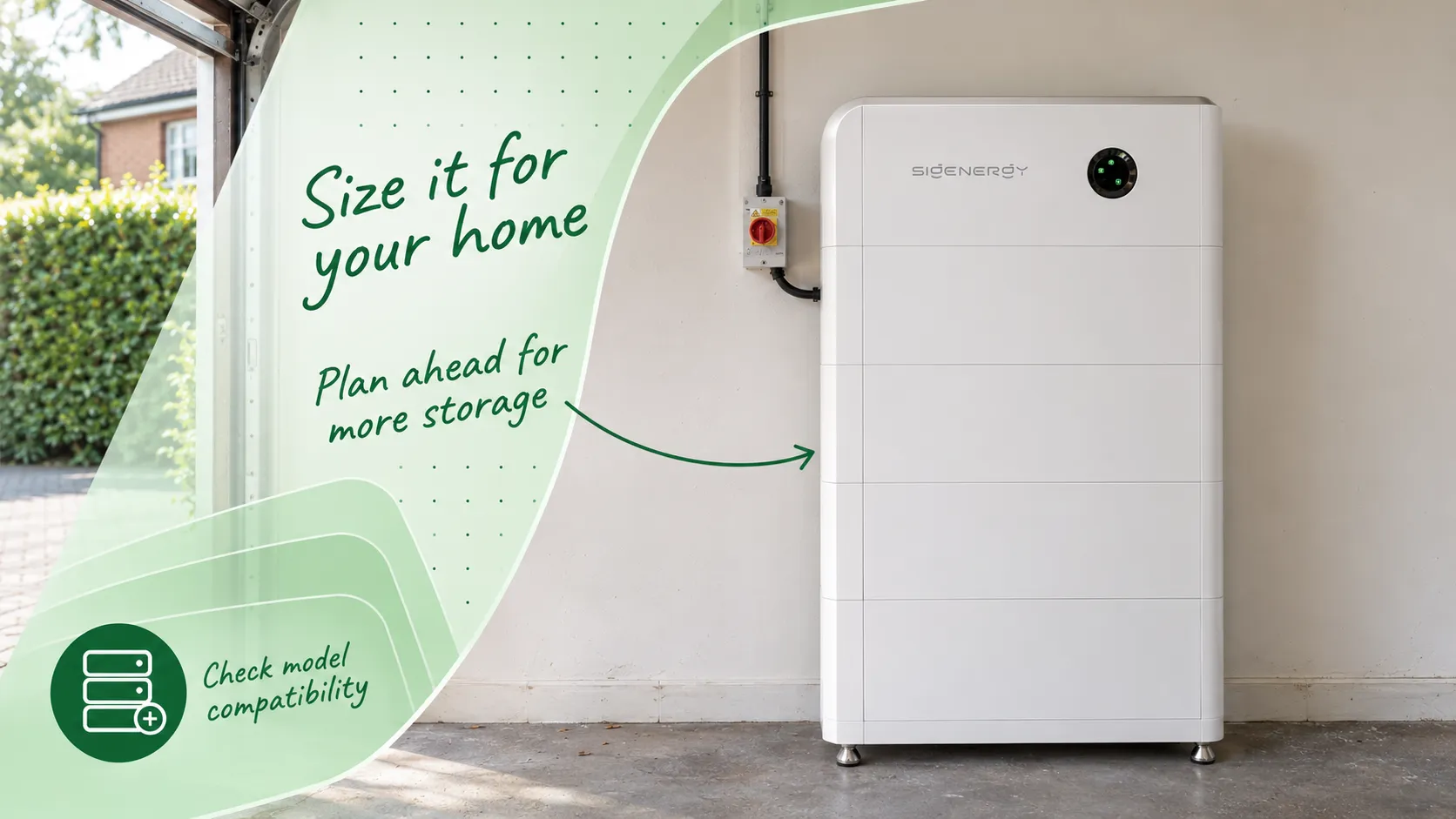
What Size Home Battery Do I Need, and Can I Add More Later?
Size a home battery to the electricity you use outside your cheap hours, in usable kWh. And why adding more later depends on the exact model, not just the brand.
JME Green Energy
JME Green Energy Team
⚡ Key Takeaways
- Size a battery to the electricity your home uses outside its cheap hours, plus any summer solar you'd otherwise export. Work in usable kWh, not the number on the box.
- A bigger battery only earns its keep if you use most of it on most days.
- Adding a battery later depends on your exact model, hardware revision and firmware. Staying with the same brand doesn't guarantee a match.
- If you already know you'll need more storage, for an EV, a heat pump or more panels, it's usually easier to fit it at the start or within the first year.
- VAT on an installed home battery is 0% until 31 March 2027, then 5% from 1 April 2027.
Search for what size battery you need and you'll find plenty of rules of thumb. None of them know when your home uses its electricity, and that's what decides the answer.
This guide shows you how to size a battery from your own meter data. It then covers whether you can add another battery in a few years' time, which depends on the exact model you buy. Manufacturers do change their models.
Product and expansion rules checked against manufacturers' own documents on 10 November 2026.
The short answer
Size your battery to the electricity you use outside your cheap tariff hours. If you have solar panels, also look at how much surplus they make on a summer day. Then convert that to usable capacity, the energy the battery can give back. It's measured in kilowatt-hours (kWh), the same units your electricity bill is counted in.
For a sense of scale, Ofgem's typical home uses 2,500 kWh of electricity a year. That's about 6.8 kWh a day on average, and more in winter. Your own figure could be well above or below that, especially with an electric car or a heat pump, which is why we start from your meter data.
A larger battery isn't automatically better. A battery saves money on the units it moves from cheap hours to dear ones (or from your roof to your evening), so storage you rarely use adds cost without adding savings.
Capacity (kWh) and output (kW)
Two numbers describe a battery. Capacity, in kWh, is how much energy it holds. Output, in kilowatts (kW), is how much power it can supply at any one moment.
A shower, an oven and an EV charger running together can ask for more power than a battery can deliver, and a bigger capacity won't change that. Our battery storage installation page explains the difference in more detail.
How to size your battery in seven steps
-
Get your half-hourly usage. Your supplier's app or account will show smart-meter data by the half hour. Look at a winter month and a summer month. Your annual total on its own isn't enough, because it doesn't show when you use the electricity.
-
Work out what you use outside the cheap window. Add up the electricity you use outside your tariff's cheap hours on a typical day. That's the most a grid-charged battery can usefully shift each day. Our Octopus tariffs guide covers how the cheap windows work on the common tariffs.
-
If you have solar, look at your summer surplus. The EU's PVGIS model gives a south-facing 5 kW system near Stirling about 12 to 19 kWh a day from March to September, and about 3 to 7 kWh a day from November to February. Only the part your home doesn't use at the time is surplus. In a Scottish winter, the battery mostly runs on cheap grid electricity.
-
Use the usable figure. Compare your daily figure with the battery's usable capacity, not its nameplate size. Tesla's Powerwall 3, for example, has 13.5 kWh usable. Allow for some energy lost going in and out of the battery, and for capacity fading gradually over the years.
-
Check the output. Make sure the battery's kW rating suits the appliances you'll run from it at the same time in the evening.
-
Add the changes you already know about. An electric car on an EV tariff usually charges straight from the grid overnight, not from the battery. But EV tariffs come with cheap overnight windows that make a larger battery worth filling. A heat pump raises your demand in winter, during the day and in the evening. Our guides to heat pumps with solar and batteries and the best time to charge an EV go into both.
-
Price the last few kWh. Compare the extra cost of the next size up, or an extra module, with the kWh you'd use from it most days. If that extra capacity would sit full or half empty, it isn't earning.
If you don't have solar, skip step 3. Our guide to a home battery without solar covers charging from the grid in more detail.
A worked example: two homes, one battery
These two homes are hypothetical, not customers. Both are on a tariff with a cheap overnight rate, and both are looking at a battery with 13.5 kWh usable.
| Home | What happens with 13.5 kWh usable |
|---|---|
| Home A: uses 11 kWh a day outside the cheap window in winter | The battery covers the whole day's use outside the cheap hours, with about 2.5 kWh to spare. Most of the capacity is working most days. |
| Home B: uses 5 kWh a day outside the cheap window | About 8.5 kWh, nearly two-thirds of the battery, sits unused on a typical day. A smaller battery would do the same job. |
Losses apply to both. If 90% of what goes in comes back out, you put in 10 kWh to get 9 back, so each kWh you use from the battery costs about 11% more than the cheap-rate price you paid for it.
We haven't put pounds on this example, because the answer depends on your tariff and the price of the battery. Our 0% VAT battery guide works through what a battery earns in pounds, with and without solar.
Can you add more batteries later?
Often, but it depends on the exact model you have, and the manufacturers' own documents show how much the rules vary.
The same brand isn't a guarantee
Tesla's system design guide says Expansion units are compatible with Powerwall 3 units with part number 1707000-xx-J or later. Going by that guide, an earlier Powerwall 3 wouldn't take an Expansion unit, even though it carries the same product name from the same manufacturer. The guide is Tesla's US edition and we haven't confirmed the rule for UK units, so we check the part number before we plan any Tesla expansion.
Solis says something similar in the manual for its IntelliHome batteries: "Future iterations of this product might not be backwards compatible and there might be implications when putting multiple products of different versions in the same system." It asks readers to consult Solis's local team to verify compatibility between generations. Its warranty also excludes mixing batteries with different rated capacities without the company's prior permission.
The inverter matters too. Solis's manual says older Solis hybrid inverters need a firmware update before they'll work with its newer SolisStorage batteries. In our experience, an inverter and battery from the same manufacturer are the simplest combination to set up and control, but even then the model and firmware have to match.
Models change
In our experience, battery models change every few years, and the exact module you have can become hard to buy. Tesla no longer sells the Powerwall 2, which it replaced with Powerwall 3. Fogstar's 16.1kWh battery has changed under the same name: units shipped from July 2024 use M8 terminals, where the first version had push connectors. Any plan to expand needs checking against what's on sale at the time.
Manufacturers set their own expansion rules
| Battery | What the manufacturer says about adding more |
|---|---|
| Tesla Powerwall 3 | Up to 4 Powerwall 3 units and up to 3 Expansion units. Expansion units connect to the Leader Powerwall 3. Tesla's US system design guide says that unit needs part number 1707000-xx-J or later. |
| Solis IntelliHome | Up to 8 units in parallel. Future versions might not be backwards compatible, so compatibility between generations has to be checked with Solis. |
| Fogstar Energy 16.1kWh | Fogstar's pages give a limit of 15 or 16 batteries in parallel, added in whole 16.1kWh units. The unit's terminals changed from July 2024 shipments. |
| SolaX T-BAT HV | SolaX's European warranty terms suggest adding extra batteries within 1 year of installation. Its manual sets conditions for new modules, including charge levels matched to within 5%. |
| Sunsynk | Voltage and charge level within 5% when adding a battery. With older SunBatt batteries, the new one goes in as the master and the originals move to the last positions. |
| Sigenergy SigenStor Neo | Sigenergy says its built-in energy optimiser lets old and new battery packs be mixed. |
These rules change with new versions, so we check the current documents for your exact model before quoting.
Old and new batteries together
Several of the manufacturers above manage old-and-new mixing with rules, such as limits on how far apart the manufacture dates can be or how closely the charge levels must match.
Where a system can't balance each battery separately, batteries connected together tend to be held back by the weakest one. A new battery added to an older, slightly faded one may not give you its full capacity.
So should you buy the extra capacity now?
If you already know you'll need more storage, because an electric car, a heat pump or more panels are coming, it's usually easier to fit it at the start or within the first year than to hunt for a matching module later. SolaX's European warranty terms, for example, suggest adding batteries within a year of installation.
If you don't know that, buy the size you'll use now and choose a system whose manufacturer documents how to add capacity later. Paying for storage you won't use, just in case, ties up money that isn't saving you anything.
Either way, keep a record of the exact model, hardware revision and firmware version when the battery is installed. If you want to expand later, that's the first thing an installer will need.
Already have a battery?
Send us the model and, if you can, a photo of its label. We'll check what expansion your manufacturer still supports and whether matching units are available. If you have a GivEnergy battery, read our guide for GivEnergy battery customers first.
Our battery storage FAQs cover related questions, including whether you can add capacity later and where a battery can go.
What about VAT?
VAT on an installed home battery is 0% until 31 March 2027, and HMRC says the rate then goes to 5% from 1 April 2027, not back to 20%. The Budget on 28 October 2026 confirmed the 5% rate, and no new battery grant has been announced. If your installation will be close to 31 March 2027, ask how your deposit and final invoice will be treated. Our 0% VAT battery guide has the full detail, including what the difference is worth.
Sources and dates
All checked on 10 November 2026.
- Ofgem, typical domestic consumption values (1 July 2026): a typical home uses 2,500 kWh of electricity a year.
- EU Joint Research Centre, PVGIS (run 6 October 2026): monthly solar generation for a south-facing 5 kW system near Stirling.
- Tesla, System Design: Expansion units and Multi-Powerwall 3 installations: Expansion unit compatibility and system limits.
- SolisStorage, IntelliHome-OD user manual V1.0 (13 August 2026): parallel limit, backwards compatibility, warranty exclusions and inverter firmware.
- Fogstar, 16.1kWh battery product page and 16.1kWh FAQ: parallel limit and connector change.
- SolaX, T-BAT SYS-HV user manual (18 November 2024) and warranty terms: expansion conditions.
- Sunsynk, Adding a new battery to an existing battery pack.
- Sigenergy, SigenStor Neo: mixing old and new battery packs.
- HMRC, VAT Notice 708/6, and the Budget 2026 overview of tax legislation and rates (updated 5 November 2026): 0% to 31 March 2027, 5% from 1 April 2027.
The 90% round-trip efficiency and the two homes in the worked example are illustrative assumptions, not measured figures.
Not sure what size you need?
Send us your usage and we'll work out a sensible size with you:
Find out more about our battery storage installation, or send us your usage and we'll talk it through.
A screenshot of a winter month and a summer month from your supplier's app is a good place to start. We're based in Dunblane and fit batteries across Central Scotland.
Related Articles

Do Solar Panels Add Value to Your Home in Scotland? What If You Move?
Solar payback in Stirling is 11 to 12 years, so is it worth it if you're older or might sell? What the research says on ...
GivEnergy Administration: What It Means for Existing Battery Customers in Scotland
GivEnergy Ltd is still in administration with no buyer. What GivEnergy battery owners in Scotland need to know about war...

Octopus Energy Tariffs in Scotland (2026): A Plain-English Guide for Solar, Battery and EV Homes
Flux, Go or Intelligent Go? A plain-English guide to picking the right Octopus tariff for Scottish homes with solar, a b...