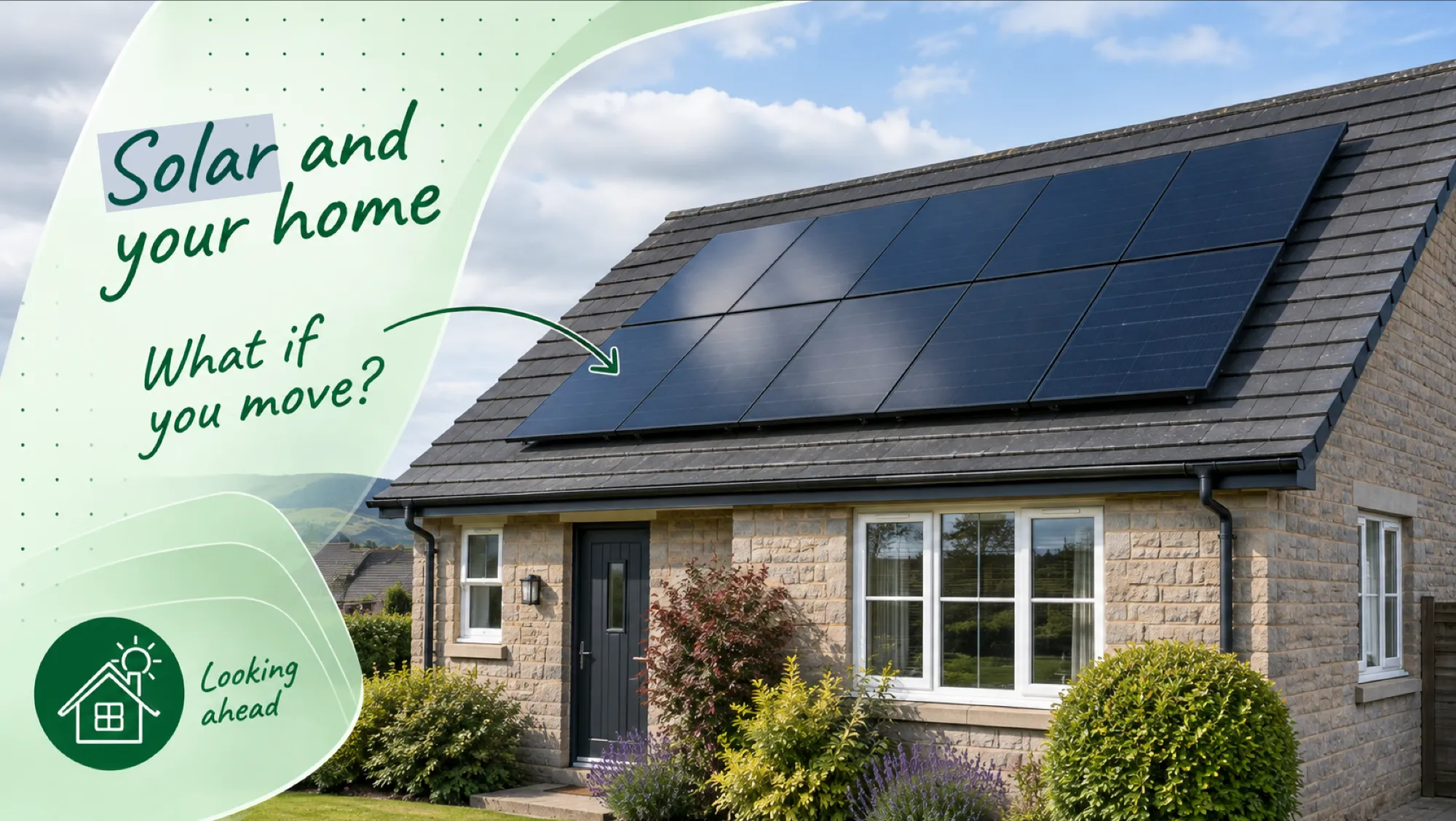
Do Solar Panels Add Value to Your Home in Scotland? What If You Move?
Solar payback in Stirling is 11 to 12 years, so is it worth it if you're older or might sell? What the research says on EPCs and house prices, and what buyers ask for.
JME Green Energy
JME Green Energy Team
Some of our older customers have told us that a payback of a decade or more feels too long, or that they may have moved by then. The payback figure counts only what the panels save on your bills and earn from export. It doesn't say whether they add anything to the price when you sell. On that, the research is mixed: UK studies range from close to nothing to a few per cent, and none of them uses Scottish sale prices.
Figures checked 10 November 2026.
We're installers, not estate agents or surveyors. Nothing on this page is valuation advice, and we can't tell you what solar would add to your house. For that, ask a local estate agent or the surveyor who prepares your Home Report.
⚡ Key Takeaways
- Payback in Stirling is 11 to 12 years on Energy Saving Trust figures (page updated 1 October 2026). That sum counts bill savings and export income only. It leaves out anything the panels might add when you sell.
- UK studies disagree. Rightmove (2023) found a 3% average price premium for homes moving from EPC D to C. A 2024 Swansea and Birmingham study found homes with solar were associated with prices 6.1% to 7.1% higher. Nationwide (June 2026) found little difference between C and D rated homes in England.
- None of these studies uses Scottish sale prices, and none can value a particular house.
- If you sell, an owned, MCS-certified installation with its paperwork in order makes the handover simpler. Export payments don't move with the house, so the buyer applies for their own.
What payback counts, and what it leaves out
Payback is the installed cost divided by what the system brings in each year: the electricity you no longer buy, plus what you're paid for the electricity you export. The Energy Saving Trust (EST) puts it at 11 to 12 years for a typical system in Stirling, the longest of the places it models. Our own worked example at October 2026 prices comes to 11.0 years, or 13.9 years on a 4.1p export rate. Our solar payback guide shows the sums and has a calculator for your own figures.
That number reads differently at 70 than at 40. EST expects panels to last 25 years or more, so a younger household can expect many years past the break-even point. If you might move in five years, you won't get there on bill savings alone, and our payback guide says so too: solar is less likely to be worth it if you expect to move in the next few years.
The payback sum has nothing to say about whether the next owner pays anything for the panels, and nobody can promise that for your house.
What the research says about solar and house prices
Some studies look at what happens to prices when a home's EPC rating improves, for any reason. Others look at homes with solar panels specifically.
Studies that found a premium
Rightmove's Greener Homes Report (July 2023) looked at 300,000 homes that sold twice in the previous 15 years, with a new EPC issued between the two sales. After removing local house price growth and allowing for floor area, homes that went from D to C carried a 3% price premium on average. That was £11,157 at the national average asking price of the time. Rightmove describes it as a correlation. The upgrades behind it include things like new windows, which also improve a home's condition, and solar isn't separated out. There's no regional breakdown, so there's no Scottish figure. An earlier Rightmove study in 2021, of over 200,000 homes, had put the D to C figure at 4%.
Knight Frank (October 2022) also found 3% for D to C, above local price growth.
A 2024 study by researchers at Swansea and Birmingham, published in Energy Economics, measured solar directly. Using Zoopla data on UK homes, it found that homes with solar panels were associated with prices 6.1% to 7.1% higher. One of the authors' checks gave a lower 3.5%, and they found the premium has been declining over time. The paper's abstract doesn't say whether these are asking or achieved prices, and Scotland isn't reported separately. This is a different measure from Rightmove's, so the two figures shouldn't be read as one range.
Studies that found little effect
Nationwide's analysis published in June 2026 is the most recent. It used Nationwide's own mortgage lending for house purchases in England during 2025, and compared similar homes. For owner-occupiers, A and B rated homes carried a "modest premium of 1.6%" over a similar D rated home. It found "little difference for properties rated C or E, compared with D".
A study for the trade body Solar Energy UK, written up in the RICS Property Journal in January 2022 with Franz Fuerst of the University of Cambridge, matched 5.7 million Land Registry sales against MCS and EPC records. It found a solar premium of 0.9% to 2%. Land Registry covers England and Wales.
| Study | What it found |
|---|---|
| Rightmove, 2023 | EPC D to C: 3% more on average. No regional split; solar not isolated |
| Knight Frank, 2022 | EPC D to C: 3% above local price growth |
| Swansea and Birmingham, 2024 | Homes with solar associated with prices 6.1% to 7.1% higher (3.5% in one check) |
| Nationwide, June 2026 | England: little difference between C and D homes; A or B homes 1.6% higher than D |
| Solar Energy UK and Cambridge, 2022 | Homes with solar 0.9% to 2% higher (England and Wales) |
These are averages across very large numbers of homes, mostly in England. They are correlations, so none of them proves the panels caused the difference, and none can tell you what a buyer will pay for your house.
What about Scotland?
We couldn't find any study of Scottish sale prices and solar, or anything published by Registers of Scotland on it.
What there is comes from a Nationwide survey of 1,000 Scottish homeowners carried out in May and June 2026. 82% said they expect buyers to pay more for an energy-efficient home, and 70% said EPC ratings or energy efficiency matter more now than when they bought. That measures what owners expect, not what buyers have paid. The same release quotes the Scottish House Condition Survey: nearly 180,000 Scottish homes, about 8%, already have solar panels, so buyers and surveyors here will have seen them before.
When you sell in Scotland, the Home Report includes the Energy Report, which is your EPC, so buyers see the rating from the start. The Scottish Government's new style of EPC has been put back to 30 April 2028 (gov.scot update, 24 August 2026), so a home sold now still carries a current-style EPC.
How solar shows up on your EPC
Scottish EPCs for existing homes have been produced with a method called RdSAP 10 since June 2025. It counts solar panels, batteries and diverters, so adding solar can raise your EPC score.
How far it moves the score depends on the house: where the score starts, the size of the system, which way the roof faces, shading, whether there's a battery, and how close the home already sits to a band boundary. A band is around 11 to 15 points wide (C runs from 69 to 80, B from 81 to 91). A home just below a boundary may move up a band, and one in the middle of a band may stay where it is. Even Barclays, which rewards solar installs, says there's "no guarantee" an improvement will raise your rating.
Your own EPC is the best guide. It lists recommended improvements and the rating each could reach, so if solar panels are on that list you can see the likely effect for your house. You can find your certificate on the Scottish EPC Register.
Green mortgages and lender cashback
This is what four lenders' own pages said on 10 November 2026. Terms change, so check with the lender before relying on any of it.
| Lender | What's on offer (10 November 2026) |
|---|---|
| Nationwide | £500 cashback when you buy a home rated A (92 or more) with a Nationwide mortgage, or £250 for a high B (86 to 91). Existing borrowers can apply for 0% Green Additional Borrowing of £5,000 to £20,000 towards improvements such as solar |
| Lloyds | £250 cashback for buying or remortgaging an A or B rated home. Existing customers can get up to £1,000 back for fitting solar panels |
| Halifax | No longer taking new mortgage applications while the brand moves to Lloyds. Existing Halifax borrowers can get £1,000 back for roof-top solar panels or a non-portable battery |
| Barclays | A lower rate on certain deals for new-build homes rated A or B, bought from the builder. Existing Barclays mortgage customers can claim £500 for fitting solar, with an MCS certificate, within three months |
Most of this helps one of two groups: people who already have a mortgage with the lender and are installing solar, or buyers of homes rated A or high B. Those ratings are uncommon in older Scottish homes: around 77% of those built before 1919 are rated D to G. Nationwide and Lloyds also refer to the government's EPC register, and Scottish certificates sit on a separate register, so ask the lender whether a Scottish EPC qualifies.
If you sell: what the buyer will ask for
The Energy Saving Trust's advice on buying a house with solar (February 2025) tells buyers what to check. It's worth having these ready:
- the MCS certificate for the installation
- the system size, and details of any battery
- the inverter's age (EST says it generally needs replacing after around 12 years)
- details of any export tariff or Feed-in Tariff, and a change of ownership form for it
- confirmation that the system is included in the sale, for example on the fixtures and fittings list
Export payments don't transfer with the house. The Smart Export Guarantee (SEG) is a contract between you and your supplier, so the buyer applies for their own. To join Octopus's SEG tariff, for example, the installation must be certified under MCS (or the FlexiOrb scheme), and there must be a half-hourly export meter. Without the MCS certificate, the next owner may not be able to get paid for exports, so keep it safe. Older systems on the Feed-in Tariff need a change of ownership with the FIT supplier, and the buyer can then claim the remaining payments.
A buyer is likely to want the warranty documents for the panels, inverter, battery and workmanship as well. Our warranty and aftercare page explains which warranties come with an installation.
Leased "rent-a-roof" systems are a different matter. The UK Finance Lenders' Handbook sets out lenders' requirements for roof leases in England and Wales, but says "At present there is no guidance for Scotland." If your panels are leased, speak to your solicitor and expect the buyer's lender to ask questions. Panels you own outright, with an MCS certificate, avoid that problem.
Solar is also turning up more often in listings. Rightmove saw almost 40% more mentions of solar panels in property descriptions of homes for sale in 2025 than in the same period a year earlier. That may make a home more appealing to some buyers. We haven't found UK evidence that homes with solar sell any faster.
Export income while you're still there
Whatever happens when you sell, the panels earn something every year you're in the house. Export rates on Octopus's own pages, checked 10 November 2026:
- 12p per kWh on Outgoing Octopus, a variable rate that needs Octopus as your electricity supplier
- 4.1p per kWh on the Octopus SEG tariff, a flat rate open to people who stay with another supplier
Octopus also has Prime Outgoing and Agile Outgoing, which pay different rates at different times of day. If you're out during the day or use little electricity, more of your solar gets exported. Exported units earn less than the units you use yourself would save, so the export rate you pick matters more for you. A battery can export at peak times on some tariffs, but how much that's worth depends on the tariff and how it's set up. Our guide to selling solar back to the grid covers how to apply.
When waiting is the right call
Waiting is a sensible decision if:
- your roof needs replacing soon
- the roof is heavily shaded or faces north
- you're likely to sell within a year or two
- you'd rather keep the money available
The sums can be redone later if things change.
Solar and house value: common questions
Sources and dates
All checked on 10 November 2026. Dates in brackets are the publication dates.
- Energy Saving Trust, Solar panels (page updated 1 October 2026): Stirling payback, panel lifetime. Payback figures as used in our payback guide (checked 6 October 2026).
- Rightmove, Greener Homes Report (July 2023) and 2021 green upgrades study (28 October 2021).
- Knight Frank, Improving your EPC rating (27 October 2022).
- Asproudis, Gedikli, Talavera and Yilmaz, "Returns to solar panels in the housing market", Energy Economics 137 (2024), doi:10.1016/j.eneco.2024.107768.
- Nationwide, House Price Index Q2 2026 (June 2026) and Scottish homeowner survey (fieldwork May to June 2026).
- RICS Property Journal, Affirming the value of solar property (14 January 2022).
- Scottish Government, EPC reform updates (updated 24 August 2026).
- Lenders' own pages: Nationwide Green Reward, Lloyds eco home offers, Halifax green living offers, Barclays Green Home Mortgage and Barclays Greener Home Reward.
- Energy Saving Trust, Buying a house with solar panels (25 February 2025).
- UK Finance, Solar panels and the Lenders' Handbook.
- Octopus Energy, Outgoing Octopus and Octopus SEG tariff (rates as shown on 10 November 2026).
- Rightmove, Do solar panels and heat pumps boost the value of a home? (undated, around 2025; the page states Rightmove is engaged in paid advertising with Octopus Energy).
Want the numbers for your own roof?
Whether solar is worth it for you depends on your roof, your electricity use and how long you expect to stay. In short:
Want to know what the installation involves? See our solar panel installation service.
We'll look at your roof and your usage and give you a payback figure for your house. If waiting makes more sense for you, that's a fine answer too.
Related Articles
What Size Home Battery Do I Need, and Can I Add More Later?
Size a home battery to the electricity you use outside your cheap hours, in usable kWh. And why adding more later depend...

Octopus Energy Tariffs in Scotland (2026): A Plain-English Guide for Solar, Battery and EV Homes
Flux, Go or Intelligent Go? A plain-English guide to picking the right Octopus tariff for Scottish homes with solar, a b...
Heat Pumps in Scotland: The Bit Nobody’s Joining Up
Why heat pumps in Scotland work best when solar panels, battery storage and heating controls are designed as one joined-...