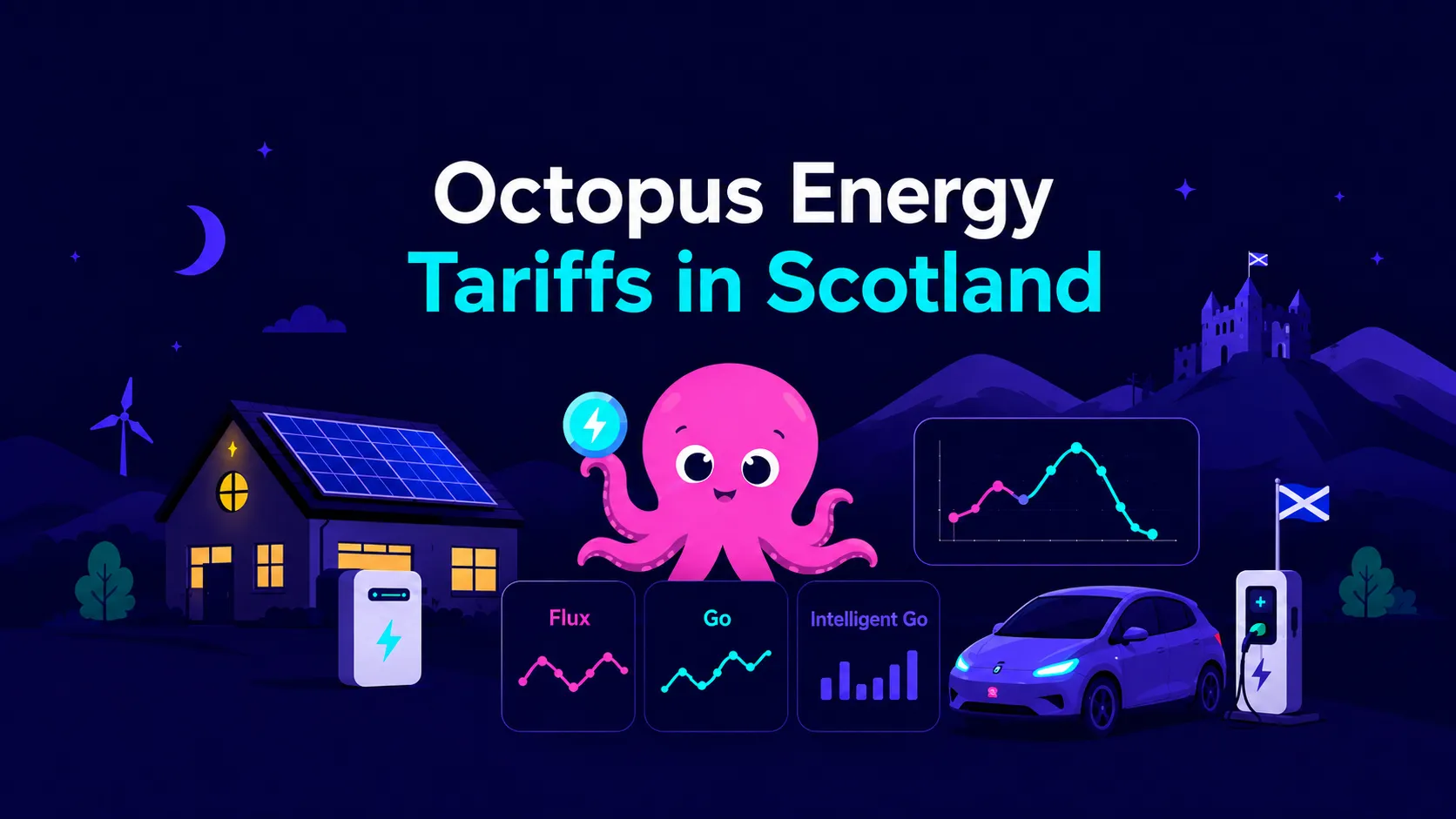
Octopus Energy Tariffs in Scotland (2026): A Plain-English Guide for Solar, Battery and EV Homes
Flux, Go or Intelligent Go? A plain-English guide to picking the right Octopus tariff for Scottish homes with solar, a battery or an EV — with today's live prices.
JME Green Energy
JME Green Energy Team
Sticking with a flat rate tariff after spending thousands buying solar panels, a home battery or an EV charger is madness. You’ve just paid for all the expensive kit, yet you’re less likely to see the cost benefits.
JME Green Energy are an Octopus Energy Trusted Partner so we’re happy to help with questions like “Which Octopus tariff should we go for?” and to give an honest answer, it all depends on what system you have installed and your usage at your property.
So to provide you with a no jargon answer. There are three tariffs that matter for homes in Scotland, who each of these tariffs are suited to and what the numbers look like currently.
In short
- Today's actual Southern Scotland prices are in the live table further down — straight from Octopus, refreshed every hour. Want just the numbers? Bookmark today's Octopus Flux rates.
- If you’ve got solar, a battery, and an EV of light use then go on Octopus Flux (or Intelligent Flux). Charging at night is cheap, you dodge the crazy grid prices by running off your battery during peak times, and peak export pays well in summer.
- If you’ve got battery only, no solar Octopus Flux works, but you’d really want to be on t’s often a better for buying off-peak and dodging the annoying spiked prices.
- Heavy EV miles, with or without solar: Octopus Go or Intelligent Go. A longer cheap window means a fuller EV charge overnight.
- Solar but no battery: Go if you've got an EV, plus Outgoing Octopus or Agile Outgoing for export. Flux import isn't really worth it without a battery.
- Rates change every few months. Always check your Octopus app before switching.
Why the tariff matters as much as the kit
The savings on a battery don't come from the battery. They come from the gap between cheap and peak electricity prices. A 10 kWh battery on a flat-rate tariff is just an expensive paperweight.
That gap is what time-of-use tariffs sell you. On Octopus Flux in Southern Scotland, as an example, you can buy a kWh at 02:00 for around 15p and avoid paying around 35p to use it at 6pm. That's roughly a 20p swing on every unit you can shift. Multiply that by a battery cycling once a day, every day, and you're talking real money.
Get the tariff wrong and thkit just sits there.
The three Octopus tariffs that actually matter
There are loads of Octopus tariffs floating around. For solar, battery and EV homes, you really only need to understand three.
| Tariff | Best fit and timing |
|---|---|
| Octopus Flux | Best for solar + battery homes. Cheap window: 02:00-05:00. Peak penalty: 16:00-19:00. |
| Octopus Go | Best for EV owners with any setup. Cheap window: 00:30-05:30. No peak penalty; flat day rate. |
| Intelligent Octopus Go | Best for EV owners with a compatible smart charger or EV. Variable cheap window, usually around 6 hours overnight. No peak penalty. |
Octopus Flux is the one designed for homes with PV and a battery. Cheap import overnight, expensive peak teatime, and a matching export tariff that pays the most when the grid's stressed. If you can shift your battery in and out at the right times, this is where the money is.
Octopus Go is the import-side EV tariff. Five hours of cheap power overnight, flat rate the rest of the day. Pair it with a separate export tariff like Outgoing Octopus, flat 12p as of March 2026, or Agile Outgoing if you fancy chasing the wholesale price.
Intelligent Octopus Go is the same idea but smarter. It works with a compatible EV or charger to schedule charging into a longer cheap window, often 6 hours rather than 5. Not every car or charger plays nicely with it, so check before you commit. Our EV charger comparison covers which units support it.
The Intelligent Flux version exists too. Same principle, same time bands, but Octopus optimises the battery for you if you've got the right inverter integration.
What does Octopus Flux actually pay in Scotland right now?
Most of central Scotland, including Stirling, Falkirk, Perth, Linlithgow, Livingston, Dunblane and the whole Forth Valley, sits in the Southern Scotland region under SP Energy Networks. Northern Scotland covers the Highlands and Islands and has a different rate sheet.
Here are the live Southern Scotland rates, pulled straight from Octopus Energy and refreshed every hour. Rates shift every quarter when Ofgem updates the price cap, so the table below is always current — no rounding required.
Live prices for the SP Energy Networks region (Southern Scotland), updated every hour. All figures are pence per kWh including VAT.
Octopus Flux — import
Buy from the grid. Charge in the cheap window, avoid the peak.
| Time band (UK) | Window | Rate |
|---|---|---|
| Cheap window | 02:00–05:00 | 14.98p/kWh |
| Standard | 05:00–16:00 | 24.96p/kWh |
| Peak window | 16:00–19:00 | 34.94p/kWh |
| Standard | 19:00–02:00 | 24.96p/kWh |
| Standing charge | Daily | 62.83p/day |
Octopus Flux — export
Sell to the grid. Peak export pays nearly 3× the standard rate.
| Time band (UK) | Window | Rate |
|---|---|---|
| Low window | 02:00–05:00 | 4.42p/kWh |
| Standard | 05:00–16:00 | 9.55p/kWh |
| Peak export | 16:00–19:00 | 27.19p/kWh |
| Standard | 19:00–02:00 | 9.55p/kWh |
Outgoing Octopus — flat export
Simple flat-rate SEG. Pairs well with Go for EV homes without batteries.
| Time band (UK) | Window | Rate |
|---|---|---|
| Flat rate | 00:00–24:00 | 12.00p/kWh |
Octopus Go — EV import
Five-hour cheap overnight window for EV charging, flat day rate.
| Time band (UK) | Window | Rate |
|---|---|---|
| Cheap window | 00:30–05:30 | 9.50p/kWh |
| Peak window | 05:30–00:30 | 32.15p/kWh |
| Standing charge | Daily | 62.83p/day |
Intelligent Octopus Go — EV import
Smart-charged variant with a longer overnight cheap window.
| Time band (UK) | Window | Rate |
|---|---|---|
| Peak window | 05:30–23:30 | 32.15p/kWh |
| Cheap window | 23:30–05:30 | 8.00p/kWh |
| Standing charge | Daily | 62.83p/day |
Last refreshed: 20 Sept 2026, 15:24. Live data straight from Octopus Energy. Always confirm in your Octopus app before switching tariffs.
For a permanent live-rates page you can bookmark, see today's Octopus tariff prices in Southern Scotland.
The peak export rate is the secret sauce of Flux. When you sell back to the grid during peak hours Octopus pays you nearly three times the standard rate. This is great when you have solar surplus or a battery still holding charge at tea time. We've seen our clients households in Scotland clear over £400 Flux exports in one summer alone.
Here's a breakdown of the figures.
The cost to charge a battery overnight is around 15p per kh, so 10 x 15p = £1.50 to charge. Bear in mind though, batteries lose around 10% in conversion losses, so you get back roughly 9 kWh. This is best used at peak hours (4-7pm) instead of buying from the grid, it would save you around £3.15. That's a saving of around £1.65 per cycle instead of buying from the grid. Do this every day and you're looking at around £600 a year in savings, and that's just from the import side. Add to this the summer exports from solar during peak times and you're looking at around £600-£800 a year in savings on Flux.
It's a no brainer when it comes to using your own stored power or selling it back to the grid — using it almost always beats exporting it. You're saving around 35p for every unit that you don't import during peak times whereas each unit you export pockets you around 27p, so every kWh you use from your own battery is around 8p more than what you'd get for selling it back to the grid. This is the reason you should prioritise using your inverter to power your propst and only then sell back the surplus.
Answers to your questions on which tariff is best suited to your house
Most articles you read on this will say it depends, we're going to be more specific here.
Q. I've got solar, a battery, and I drive a normal amount — which tariff?
The answer is almost always the Flux tariff. For example, a house in Stirling with a 4–6kWp array and a 10kWh battery with an EV averaging around 8,000 miles each year is the sweet spot. The battery can be charged on the cheap overnight in winter, and in the brighter months you can rely more on solar and get your peak export earnings when there's surplus.
Q. I've got a battery but no solar yet. What should I be on?
This is one we know well. Battery-without-solar setups work brilliantly in Scotland, and Flux is fine, but Agile often beats it. Without solar, you don't need the peak export rate. What you need is the cheapest possible overnight import. Agile's overnight prices have gone below zero dozens of hours this year in Southern Scotland. That's electricity Octopus is literally paying you to take.
For most battery-only customers we'd recommend Agile import + Outgoing Fixed for export. Simple, profitable, doesn't require any solar.
Q. I've got solar but no battery. What now?
Honestly? Get a battery. But until then, Octopus Go if you've got an EV, paired with a SEG export tariff like Outgoing Octopus or Agile Outgoing. Flux import isn't great without a battery to shift energy with. The higher peak rate hurts you more than the cheap overnight rate helps.
Q. I'm doing 200+ miles a week in an EV. Flux or Go?
Go or Intelligent Go. Five or six hours of cheap charging every night beats a three-hour Flux window when you're putting serious miles on a car. A 60kWh EV needs roughly 8 hours on a 7kW charger to fill from empty. The longer the cheap window, the more of that fits inside it.
Q. How do V2G and the Octopus Power Pack work?
Octopus Power Pack is the name of their V2G (Vehicle-to-Grid) tariff. This is when your EV battery can be used as a home battery that the grid can draw from, and Octopus pays you for letting them use it. We've covered V2G in full in our Scotland guide. If you have a V2G-compatible car like the Nissan Leaf or certain Kias and Hyundais, the tariff that makes sense changes entirely. Power Pack customers are on their own custom arrangement rather than Flux or Go.
Getting your kit set up properly matters as much as picking the tariff.
The right tariff is only part of the solution. The other part is making sure your settings are right.
For the battery scheduler on Flux, set the charge window to 02:00–05:00 in the darker months. In the brighter months, disable overnight charging, that way the solar fills the battery the next day instead of you paying to fill it overnight. Most apps do this weather-based scheduling automatically nowadays.
It's important that you keep 20–30% of charge reserved in the battery, this allows room to capture solar generation as the day warms up. During the 4–7pm peak, the battery should prie powering your property first, and only let surplus go to export after the house has used what it needs.
Your EV charger is best used with the app scheduler on a Zappi, Hypervolt, Ohme etc. to lock charging into the cheap overnight window. If you have solar installed, a Zappi in Eco+ mode will divert genuine solar surplus to your car. The placement of your CT clamp is critical here. If it isn't on the correct wire, the charger will incorrectly read your grid imports as solar surplus, so it pulls expensive power from the grid while thinking it's free. We've seen this on installs we've gone in to fix. Not the charger's fault. The installer's.
Export limits. Single-phase G98 caps you at 3.68 kW of export. If your inverter and battery can push more than that during the peak window, you'll need either G99 approval from the DNO or proper export limiting configured. This is a conversation we have with every customer at survey stage. Pushing 5kW out the wall when you're approved for 3.68kW is a fast route to an angry letter from SP Energy Networks.
What about other suppliers?
We're an Octopus Trusted Partner so we'll be honest: we think Octopus does this best at the moment. But you've got options.
OVO Charge Anytime is a smart EV charging add-on. Pair it with an OVO import tariff and OVO's SEG export and you're in the right ballpark for EV-heavy households.
E.ON Next Drive runs a similar overnight cheap window for EVs.
ScottishPower offer EV Saver and EV Optimise tariffs plus their own SEG export.
If you're not currently with Octopus and you'd like to switch, we have a referral link that gets you £50 credit on your first bill. We'd never push you to switch if your current setup is working, but if you're on a flat-rate tariff with a battery, you're losing money every single day.
VAT, grants and the bit nobody mentions
A few things to know before you commit to anything.
0% VAT on energy-saving materials until 31 March 2027. This applies to solar, batteries, including standalone batteries with no solar, heat umps and smart diverters. On a £6,000 battery install, that's roughly £1,000 you're not paying. It's a meaningful chunk.
Home Energy Scotland funding has shifted. The HES Grant & Loan currently prioritises clean heating, such as heat pumps, and insulation. Standalone solar and battery installs aren't typically funded as they were a few years ago, except in specific bundled packages. Always check the HES website directly. Eligibility moves around.
ECO4 can fund batteries for low-income households as part of a whole-house energy upgrade. It's worth a five-minute conversation if you think you might qualify.
At JME Energy we design and install MCS certified solar, batter, EV and Heat pumps across central Scotland including Stirling, Dunblane, Falkirk, Perth and the Lothians. Contact us today to get a fixed price quote.
Related Articles
GivEnergy Administration: What It Means for Existing Battery Customers in Scotland
GivEnergy Ltd entered administration in April 2026. Here's what existing GivEnergy battery customers in Scotland need to...
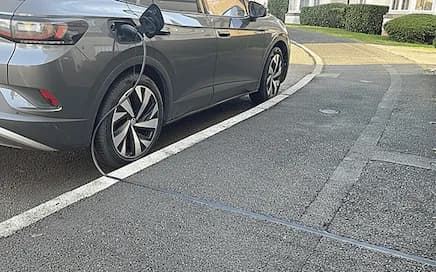
Stop Trailing Cables: The £3,500 Grant for Pavement Charging
Up to £3,500 for cross-pavement EV charging in East Lothian, Perth and Kinross, and Renfrewshire. Who qualifies, what it...
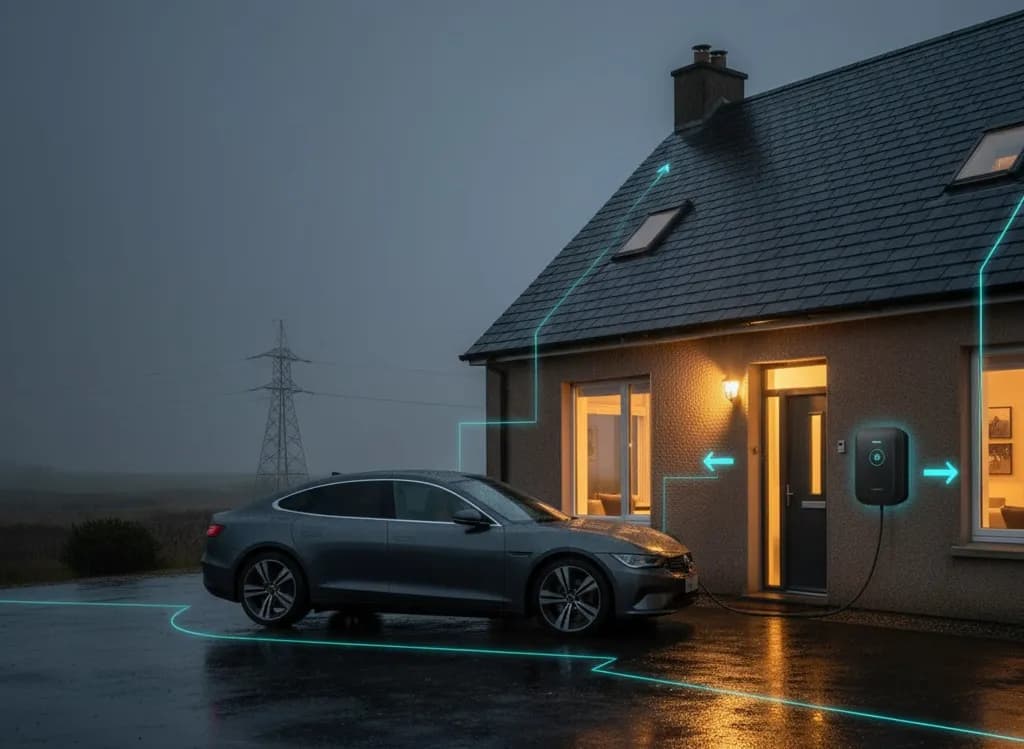
Vehicle to Grid (V2G) in Scotland: Is It Ready?
V2G, V2H and V2L explained for Scotland. What’s live now, which cars work, DNO approvals (G99/G100), and how deals like ...