Heat Pumps in Scotland: The Bit Nobody’s Joining Up
Why heat pumps in Scotland work best when solar panels, battery storage and heating controls are designed as one joined-up system.
JME Green Energy
JME Green Energy Team
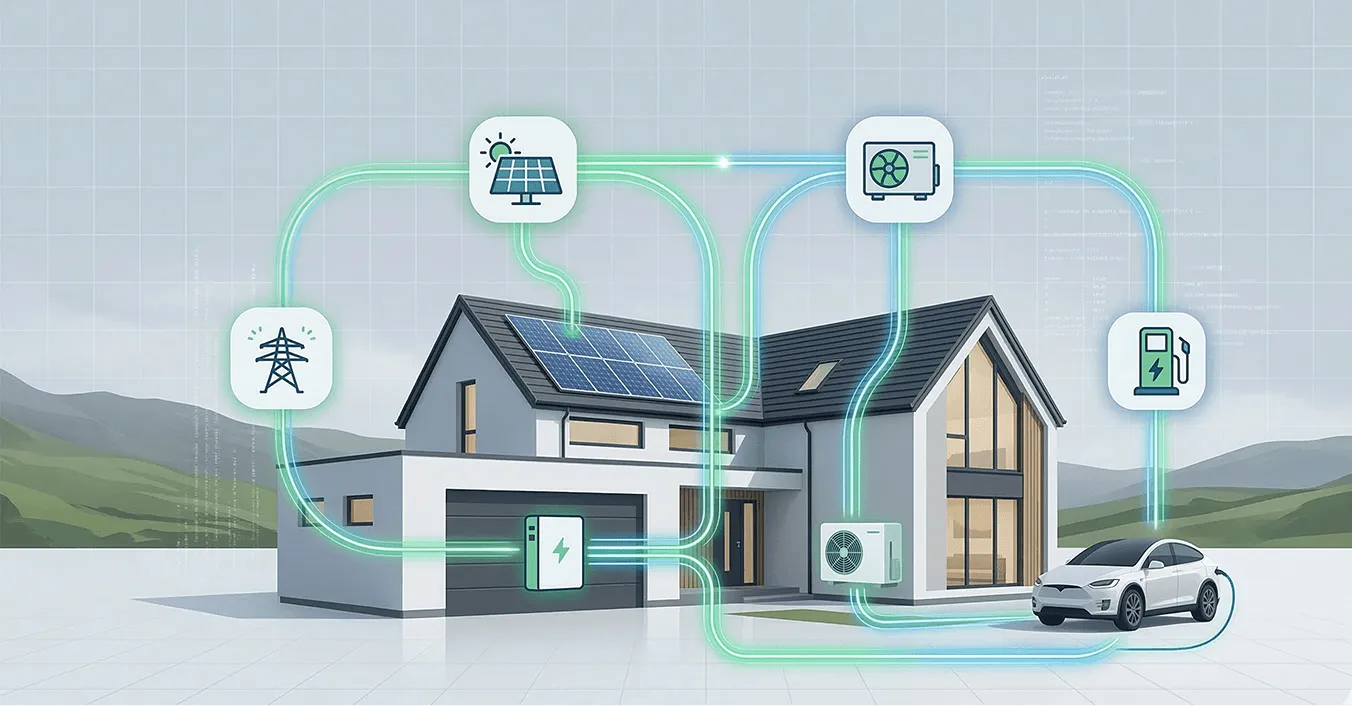
Picture a house where one company installed the solar panels, another fitted the battery, and a plumber put in a Vaillant aroTHERM heat pump. None of them checked what the others had done.
The heat pump pulls electricity from the grid at the full unit rate while a fully charged battery sits idle in the garage, because nobody configured the battery to supply the heating. The house runs like this and no one notices.
Each trade installed good equipment, but nobody joined it up into one system.
That’s why we design heating alongside our solar and battery work. Too often, heating ends up completely isolated from the rest of the house.
At a Glance
Built for Scottish weather
Heat pumps can work well in Scotland when the system is designed properly and commissioned at the right flow temperature.
Works better with solar
Solar panels can help run a heat pump during the day, cutting imported electricity and improving running costs.
Battery storage adds control
A home battery can charge overnight on a cheap tariff and then supply the heat pump when electricity is more expensive.
System design is everything
Room-by-room heat loss, radiator sizing, weather compensation and commissioning matter more than the badge on the box.
The Biggest Energy User in Your House
People worry about small things like phone chargers and lights, but a phone charger only draws a few watts. Space heating and hot water usually make up the biggest share of a home's energy use.
With gas heating, you have almost no control. If gas prices go up, you pay them. You can't generate gas on your roof, store it in a battery or buy it cheaply at 2am.
Electricity gives you options. When your heating runs on electricity, you can:
- generate power with solar panels
- store it in a home battery
- use tariffs with cheaper hours for heat pump homes, like Octopus's Cosy
- automate when your heating runs
These options give homeowners more ways to manage heating costs.
Why Heat Pumps Are So Efficient
A typical gas boiler is roughly 90–92% efficient, so you get about 92p worth of heat from every £1 of gas.
A heat pump works differently. It moves heat rather than creating it. A well-designed heat pump can deliver around 3 units of heat for every unit of electricity it uses. That ratio is called the Coefficient of Performance (COP), so this heat pump has a COP of around 3.
Instead of burning fuel, the heat pump collects heat from the air outside. That’s why a heat pump can cost less to run than a gas boiler even when electricity costs more per unit than gas, depending on its efficiency and the electricity and gas tariffs being compared.
“But Heat Pumps Don’t Work in the Cold”
It's a common worry in Scotland, but it doesn’t hold up. Norway, Sweden and Finland have some of the highest heat pump adoption rates in the world, and their winters are far colder than ours.
Heat pumps can work in cold weather. Their performance depends on the outdoor temperature, the unit selected, the home's heat loss, radiator sizing and how the system is commissioned.
Gas boilers heat radiators to around 60–65°C. Heat pumps work best at around 35–45°C. If your radiators were designed for higher temperatures, some rooms may struggle to heat properly at lower flow temperatures.
That’s why a proper installation needs:
- Room-by-room heat loss calculations (MIS 3005 standard)
- Correct radiator sizing
- Weather compensation controls
- Proper commissioning
Skip those steps and the system can end up running hotter than it needs to. Say an installer sets the flow temperature to 55°C because the radiators are too small to heat the rooms at anything lower. At a higher flow temperature, a heat pump generally has to work harder and uses more electricity for the same heat. If the radiators are upgraded so the flow temperature can come down to around 40°C, efficiency will generally improve. How much depends on the heat pump, the radiators and how much heat the house loses, which is what the heat loss calculation is for.
You shouldn't end up paying higher bills just because nobody set the system up properly.
When Solar, Battery and Heat Pumps Work Together
Combine solar panels, battery storage and a heat pump, and you have a complete energy system for your home.
As an illustration, a 5 kWp array near Stirling averages about 19.5 kWh a day in May, according to the EU's PVGIS model, and more on a clear day. Say the home uses 8 kWh of that during the day. The remaining solar electricity can be allocated between battery charging, hot water (through a solar diverter) and the heat pump, depending on demand, battery capacity and the controls.
That heat isn't quite free. Every unit you use is a unit you're not paid to export, which was 4.1p to 12p a unit on common export tariffs when we checked on 6 October 2026 (Octopus SEG, Outgoing Octopus). But it's far cheaper than importing at the Ofgem price cap of 26.32p.
In winter, solar production drops, but a battery still helps.
For example, Octopus's Cosy tariff, for homes with a heat pump or other electric heating, had three cheap periods in South Scotland on 6 October 2026: 12.19p a unit from 04:00 to 07:00, 13:00 to 16:00 and 22:00 to midnight, against 37.28p from 16:00 to 19:00. A battery filled in the cheap hours and used in that peak saves about 23.7p for each unit it gives back, allowing for 10% lost in the round trip. It only saves on the units your heat pump and home actually use between 4pm and 7pm, and a heat pump can often run in the cheap hours directly. So we don't put a yearly figure on it without looking at your home, and the saving depends on everything being configured properly.
Heat Pump Grants in Scotland
Home Energy Scotland offers grants and interest-free loans for heat pump installations. These are the main conditions as we read them on 6 October 2026; the full terms and conditions decide.
Homeowners can receive:
- Up to £7,500 grant toward installation
- Up to £7,500 more as an optional interest-free loan
- Rural and island homes may qualify for an extra £1,500 of grant, so up to £9,000
The home must be in Scotland, already built, and your own only or main home.
The system must:
- Provide 100% of the home's heating and hot water (hybrid heat pumps aren't eligible)
- Be installed by an MCS-certified installer, using an MCS or Solar Keymark certified product
On paperwork and costs:
- You don't need a qualifying EPC to apply for heat pump funding. HES only asks for one at application for insulation and other energy efficiency measures.
- You do need an updated EPC after the work is done, before HES will issue the funding. You pay for it, but can add the cost to the loan.
- Loan funding carries an administration fee of 1.5% of the loan, up to £150 per application, and HES runs affordability and credit checks.
- Work mustn't start until you have a written funding offer, and you then have nine months to finish and claim.
Solar panels and battery storage are not included. They were removed from the scheme on 6 June 2024, even when installed alongside a heat pump.
Will a Heat Pump Actually Save Money?
Sometimes. Anyone who promises guaranteed savings without seeing your house is guessing.
Running costs depend on things like:
- insulation levels
- radiator sizing and flow temperature
- system design and commissioning
- electricity tariff
- solar generation
- battery storage and how it's set up
A well-designed heat pump can cost less to run than gas, but that depends on its efficiency and the electricity and gas tariffs being compared. Poor design or commissioning can increase electricity use.
Why System Design Matters
When different trades install equipment without coordinating their work, problems can arise. For example:
- Consumer units don’t have enough capacity
- Solar diverters aren't configured with heating controls
- EV chargers trip circuits when the heat pump starts
- Batteries aren't connected to heating loads
The equipment is good, but nobody designed it as one system.
When solar panels, batteries, heat pumps and EV chargers share a home, their design and controls need to be coordinated, including when equipment is added later.
That coordination is also why we don't treat the plumbing as someone else's problem. On bigger jobs, the radiators may need resizing or the hot water cylinder may need replacing before the heat pump can run at a low flow temperature. For that work we bring in Macara Heating, a Gas Safe registered heating engineer, and design the wet side (radiators and cylinder) at the same time as the electrical side.
Thinking About a Heat Pump?
We install heat pump systems across Central Scotland, including:
- Stirling
- Falkirk
- Livingston
- Edinburgh
- Perth
If you're considering a heat pump or want to understand how it could work with solar panels and battery storage, give us a call.
For Home Energy Scotland funding, the installer must be MCS certified for heat pumps, so ask any installer for their certificate before you apply.
And if a heat pump isn't right for your property, we'll tell you that too.
TL;DR
Problems can arise when:
- systems aren’t designed properly
- solar, battery and heating controls aren't coordinated, in homes that have them
- installers don't configure controls correctly
When a heat pump system is designed and commissioned properly, it can be one of the most efficient ways to heat a home.
Frequently Asked Questions
Heat Pump FAQs for Scotland
Common questions homeowners ask when comparing heat pumps, solar panels and battery storage in Scotland.
Need a joined-up heat pump system in Central Scotland?
We design heat pumps, solar panels and battery storage to work together so you are not left with good equipment running as disconnected parts.
Book a surveyRelated Articles
Solar Panel Grants in Scotland 2026: What You Can Actually Get
Home Energy Scotland stopped funding solar and batteries in June 2024. What's left in 2026: means-tested schemes, landlo...
Business EV Charging: Stop Wasting Money on Fuel
A current guide to commercial EV charging in Scotland, including the Workplace Charging Scheme, tax allowances, charger ...
Stop Trailing Cables: The £3,500 Grant for Pavement Charging
Up to £3,500 for cross-pavement EV charging in East Lothian, Perth and Kinross, and Renfrewshire. Who qualifies, what it...