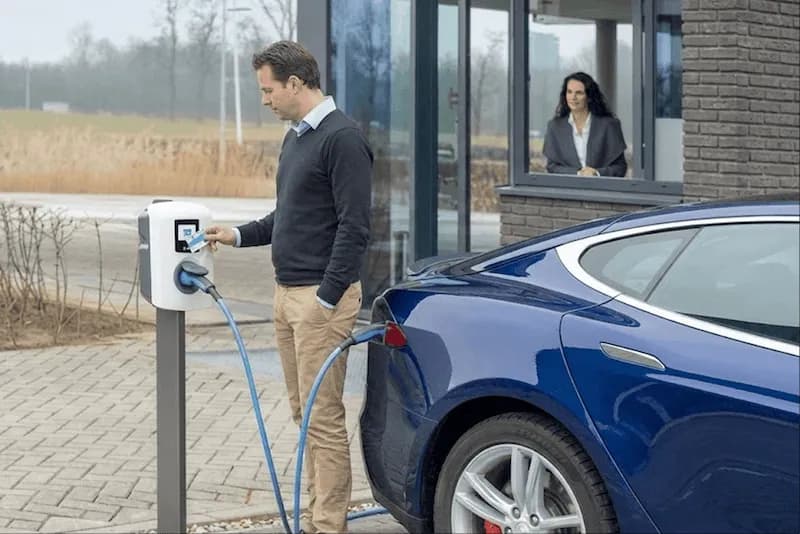
Business EV Charging: Stop Wasting Money on Fuel
A current guide to commercial EV charging in Scotland, including the Workplace Charging Scheme, tax allowances, charger speeds and site planning.
JME Green Energy
JME Green Energy Team
Your fuel bill is ugly. It’s not getting better.
More staff and fleet drivers are switching to electric cars, making dependable workplace charging increasingly useful.
Commercial EV charging is an investment, but eligible organisations can reduce the upfront cost through the Workplace Charging Scheme. Qualifying chargepoint equipment may also be eligible for a 100% first-year capital allowance. Grant and tax-relief eligibility are separate, and businesses should confirm the tax treatment with their accountant.
Both routes currently run to spring 2027, so there is time to assess the electrical supply and choose the right system rather than rushing into unsuitable equipment.
Eligible sites can receive 75% up to £500 per socket, for up to 40 sockets, until March 2027.
100% First Year Allowance lets you write off full cost against profits.
The staff and fleet infrastructure grant closed in March 2026, so budget future cabling into the project.
Stick to 7kW for staff parking. 22kW is often overkill and costly.
Smart tech avoids expensive grid upgrades by managing power usage.
1. Current Grant Support
The main UK-wide option for ordinary workplace chargepoints is the Workplace Charging Scheme (WCS).
The Easy One (WCS)
For eligible businesses, charities and public-sector organisations, the WCS covers 75% of eligible purchase and installation costs, up to £500 per socket. An organisation can apply for support for up to 40 sockets across its sites.
The maximum theoretical support is therefore £20,000, but the actual award cannot exceed 75% of eligible costs and depends on the applicant, site and installation meeting the rules. The customer applies first; after approval, an OZEV-authorised installer completes the work and claims the grant. The scheme is currently scheduled to end on 31 March 2027.
Don’t Dig Twice
Here is a rule for construction: never dig the same hole twice. It’s expensive and annoying.
If you are breaking ground, plan the likely future number of sockets before work begins. Oversized ducts, sensible distribution-board capacity and a scalable load-management system can make later expansion less disruptive.
The former EV infrastructure grant for staff and fleets closed to customer applications on 31 March 2026. Do not include that closed scheme in a project budget. The current WCS supports installed chargepoint sockets, subject to its eligibility rules.
The Scottish Rural Angle
If you operate in the Central Belt, you can scroll past this section.
Additional Scottish programmes are sometimes opened for specific regions, fleets or public charging projects, but they are not a general entitlement for rural businesses. Check the current Transport Scotland and Energy Saving Trust listings before including any additional funding in a business case.
2. The Tax Relief (Actually Better than the Grant)
Tax relief can be valuable, but the result depends on the business's tax position.
The 100% First Year Allowance allows you to write off the full cost of the equipment against your profits in year one.
For example, £10,000 of fully qualifying expenditure could reduce taxable profit by £10,000. At a 25% Corporation Tax rate, that would reduce the tax bill by £2,500, assuming the business has sufficient taxable profit. This is an illustration, not tax advice.
The dedicated 100% first-year allowance for qualifying EV chargepoint equipment is currently available for expenditure incurred by 31 March 2027 for Corporation Tax or 5 April 2027 for Income Tax.
3. Speed: Don't Buy What You Don't Need
We get asked this constantly: "Do I need the 22kW super-fast ones?"
No. You probably don't.
For vehicles parked for a full working day, 7kW sockets are often sufficient. Sites with short dwell times or high daily mileage may need more power.
7kW charging: An eight-hour working day can add roughly 56kWh before charging losses, although the actual energy delivered depends on the vehicle, battery state and any load management. It can normally use a single-phase supply.
22kW charging: This normally needs three-phase power, and the vehicle must support that AC charging rate. A supply or network upgrade may be needed, so check the site capacity before ordering equipment.
4. Making Money (The Rules)
Can you sell the electricity? Yes.
Modern commercial chargers use a standard called OCPP. It lets you set the price.
For Staff: Base any tariff on the organisation's actual electricity, management and maintenance costs. Business electricity prices differ from domestic price-cap rates.
For the Public: Public access can create revenue, but it adds payment, accessibility, signage, maintenance and tax considerations. Model utilisation and operating costs before assuming the charger will repay its installation cost.
5. The Installation (The Scary Part)
Putting these in isn't like wiring a plug socket. The biggest headache is the DNO (the grid).
When we apply to connect you, the grid might say "No." They might say your building is full. They might ask for £10,000 to upgrade the transformer down the street.
Load balancing can reduce charging power when the building's other demand is high. It may avoid or reduce an upgrade, but only a site survey and network assessment can confirm that.
6. What Does it Cost?
Every job is different. For early budgeting only, a straightforward commercial 7kW wall unit may cost roughly £1,000–£1,800 installed, while a pedestal installation may be around £2,500–£3,500 before unusually long cable runs, supply upgrades or substantial groundworks. These are indicative market ranges, not fixed prices.
The Bottom Line
The WCS is currently scheduled to end on 31 March 2027. The 100% first-year allowance has a 31 March 2027 Corporation Tax deadline and a 5 April 2027 Income Tax deadline. Whether both apply to the same project depends on the grant accounting, qualifying expenditure and the business's tax position, so confirm the treatment with an accountant.
It’s not just about being green. It’s about hiring. Good staff drive EVs. If you don't have a plug, they’ll go to the guy down the road who does.
Want a price?
We work across Stirling, Falkirk, and the Central Belt. We’ll assess your supply, handle the grid paperwork, and help you check the current grant criteria.
Get a Free SurveyFrequently Asked Questions
Common questions about commercial EV charging in Scotland
Related Articles
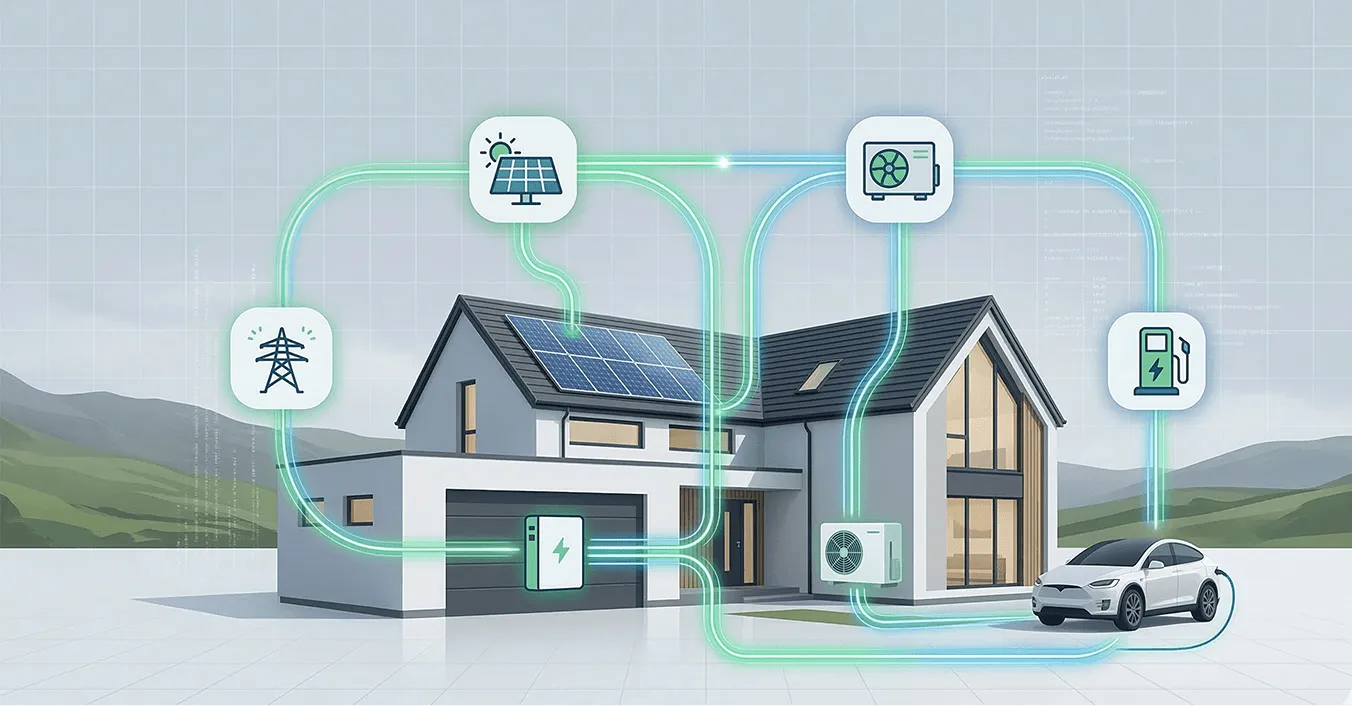
Heat Pumps in Scotland: The Bit Nobody’s Joining Up
Why heat pumps in Scotland work best when solar panels, battery storage and heating controls are designed as one joined-...
Solar Panel Grants in Scotland 2026: What You Can Actually Get
Home Energy Scotland stopped funding solar and batteries in June 2024. What's left in 2026: means-tested schemes, landlo...
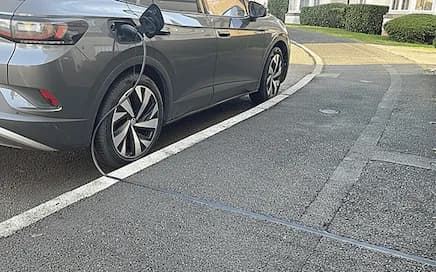
Stop Trailing Cables: The £3,500 Grant for Pavement Charging
Up to £3,500 for cross-pavement EV charging in East Lothian, Perth and Kinross, and Renfrewshire. Who qualifies, what it...