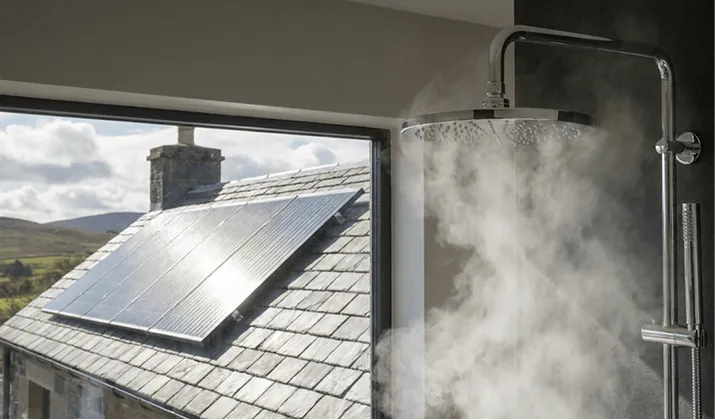
Solar PV Diverters in Scotland: Free Hot Water from Your Solar Panels (A Clear Guide)
Stop exporting solar for 4p and buying back for 27p. Solar diverters in Scotland provide free hot water and save £200-500/year. MCS installation across Central Scotland (Stirling, Falkirk, Perth & West Lothian).
JME Green Energy
JME Green Energy Team
It's not uncommon for people with solar panels on their roof to be unaware that they're basically giving electricity away. You generate power, your house uses what it needs, and the rest goes back to the grid. The grid pays you between 4p and 15p for it (depending on your SEG tariff). Then later on when you want to use hot water, you buy electricity back at 27p.
Nobody would sell something for 4p and buy it back for 27p unless they were unaware that they were doing so. But that's what's happening in thousands of homes across Scotland right now because nobody's told them about solar PV diverters.
A diverter, or otherwise known as solar immersion controllers, grabs that surplus electricity before it leaves your house and sends it to your immersion heater instead. Your water gets hot, your boiler stays off, and you've spent nothing.
This is Not Solar Thermal
We need to get this out the way because the confusion comes up more often than not.
Solar thermal is a completely separate system. Different panels on your roof, pipes full of glycol, a pump station, plumbing work, the whole works. Expensive to fit, another thing to maintain, and it's honestly not that common on new installs anymore.
A solar PV diverter uses the panels you've already got. The electric ones. It's a wee box about the size of a router that goes near your consumer unit or your hot water tank. No new panels, no plumber, no holes in your walls. Sparky work only.
What it does is simple: it monitors how much electricity your panels are making versus how much your house is actually using, and when there's a surplus it diverts that exact amount to your immersion element. If there's 400 watts going spare, 400 watts goes to the tank. If a cloud comes over and your generation drops, it backs off straight away so you're never pulling from the grid to heat water.
Once it's fitted you never touch it. It just runs.
So What Does This Actually Save You?
An average Scottish household with solar panels exports roughly 2,000 kWh a year. On a standard 4p SEG tariff that's only £80 coming back to you.
Sounds decent until you realise you're then spending 27p per unit heating your water with grid electricity. However, if you used those same 2,000 kWh to heat water you'd avoid buying £540 worth of grid electricity (at 27p/kWh). That is a potential saving of £460 a year compared to exporting it for pennies. Even on a better export tariff, the savings are substantial.
Some of the systems we've fitted are saving closer to £400 or £500 a year, particularly on bigger 4kW+ systems where there's a lot of surplus in the summer months.
Equipment runs between £170 and £440 depending on which unit you go for. Installation's half a day. Most people see the thing pay for itself within about 18 months, which honestly is hard to beat. If you've already got a battery as part of your solar package, which is how we'd usually recommend setting up a system, the diverter catches whatever surplus the battery can't absorb. They work as a team. If you haven't got a battery yet and you're not ready for that investment, the diverter on its own is a great place to start.
Which Diverter Should You Get?
Between the three main ones, here's an honest take.
The SOLiC 200
This is the one we'd point most people toward if budget matters, and budget usually matters. Around £170 to £200 for the unit. British made. No fan, no moving parts, completely silent. Some of these have been running for a decade without anyone touching them.
There's no app though. No display, no Wi-Fi, no graphs. You fit it and forget it exists. If you're the kind of person who wants to watch real time data on your phone, this will frustrate you. If you just want cheaper hot water and couldn't care less about dashboards, it's brilliant.
Twenty five year design life, supposedly. We've no reason to doubt it given how simple the things are inside.
The Solar iBoost+
About £307 and the most popular diverter in the UK, over 150,000 installed. Safe choice. Good installer support. You can add a wireless display called the Buddy which shows what's being diverted in real time, which is actually quite satisfying to watch on a sunny day.
It can run two devices as well, so immersion heater plus an electric towel rail or a radiator in the spare room or whatever you fancy.
One thing nobody mentions in the reviews is that it's got a small cooling fan. You can hear it running when it's actively diverting. It's not going to keep you awake at night, but if the unit ends up in your hallway or near a quiet room, you'll notice the hum. Worth knowing before you decide where to mount it.
The MyEnergi Eddi
This one's £439 and it's the premium option. Smartphone app, three output devices, wireless connectivity, the works.
Honestly? Unless you've already got a MyEnergi Zappi EV charger or you're planning a full smart energy system with their Libbi battery, it's overkill for most folk. You're paying nearly three times what a SOLiC costs for features that only really shine if you're deep into the MyEnergi ecosystem. If you are, it's brilliant, the way the Eddi, Zappi and Libbi talk to each other and decide what to prioritise is genuinely clever. But if you just want hot water from your surplus solar, you don't need to spend £439 to get it.
Can Your Home Have One?
This is short because it's straightforward.
You need solar panels (3kW system minimum is the recommendation, smaller still works in summer), a hot water cylinder with an immersion element in it (which is common in many Scottish homes, particularly those that haven't been retrofitted with a combi boiler), and surplus electricity to divert. If you haven't got a battery and your house is empty during the day, you'll have plenty of surplus. That covers most people.
The one scenario where a diverter's no use: combi boilers with no hot water tank. No cylinder means nowhere to dump the heat. If that's you, a battery's probably your better option, give us a call and we'll talk it through.
What Happens When We Turn Up
The install itself is quick. Two to four hours depending on how your house is wired up and where things are located.
We check the immersion element first. No point fitting a diverter if your immersion's corroded or the element's gone, you'd just be sending electricity into a dead end. Then it's mounting the unit, clamping a CT sensor to your main feed so it can read generation and consumption, wiring into the immersion circuit, and commissioning the whole thing to make sure it's behaving.
One thing we prioritise is electrical safety and compliance. While some installers might just plug these units in, we hardwire them correctly into your consumer unit with the proper circuit protection, adhering to BS 7671 Wiring Regulations. We ensure the job is safe, neat, and compliant, and we've seen systems where the original solar installer didn't even do the first notification properly. We sort it.
Your panels keep generating throughout the install. No downtime, no mess, hot water by teatime.
"Should I Just Get a Battery?"
Depends what you can spend.
A battery stores electricity you can use for anything from lights, telly, fridge, whatever - in the evening when your panels aren't generating. Brilliant bit of kit. Also five grand minimum, usually more.
A diverter stores energy as heat in your water tank. Less versatile but a fraction of the price.
If you can afford both, get both. We'd set it up so the battery charges first (because electricity's more flexible than hot water), and once the battery's full the diverter grabs whatever's left for the immersion. Anything still going spare after that exports for your SEG payments. Nothing gets wasted.
If you can only do one right now, a diverter gets you saving from day one while you plan the battery for later. Most of our customers end up getting both, the diverter just tends to come first because it's quick to fit and the payback is almost immediate.
The Questions Everyone Asks
Common questions about solar PV diverters in Scotland
Enough Reading — Here's the Point
Every sunny day without a diverter, you're handing free electricity to the grid and paying to heat your water separately. Once you know that, it's hard to un-know it.
We fit solar diverters across Stirling, Edinburgh, Livingston, Falkirk, Perth, everywhere in between. Installed by MCS-certified engineers., fixed pricing, and you talk to the people who actually do the work, not a call centre.
Get Free Hot Water from Your Solar Panels
We fit solar diverters across Stirling, Edinburgh, Livingston, Falkirk, Perth and everywhere in between. Installed by MCS-certified solar engineers, fixed pricing, and you talk to the people who actually do the work.
Get a Free QuoteRelated Articles
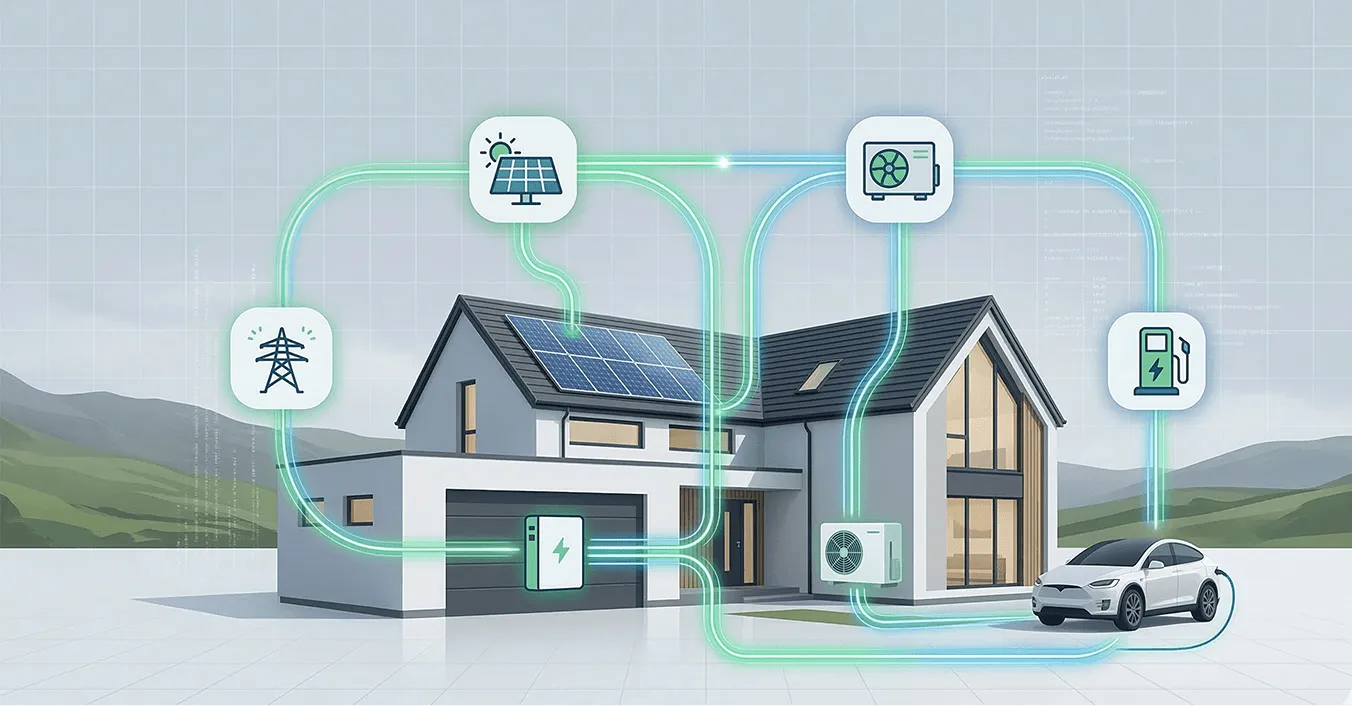
Heat Pumps in Scotland: The Bit Nobody’s Joining Up
Why heat pumps in Scotland work best when solar panels, battery storage and heating controls are designed as one joined-...
Business EV Charging: Stop Wasting Money on Fuel
A current guide to commercial EV charging in Scotland, including the Workplace Charging Scheme, tax allowances, charger ...
Is Commercial Solar Worth It for Scottish Businesses?
The honest numbers on commercial solar in Scotland — tax relief, business rates exemption, payback periods and what the ...