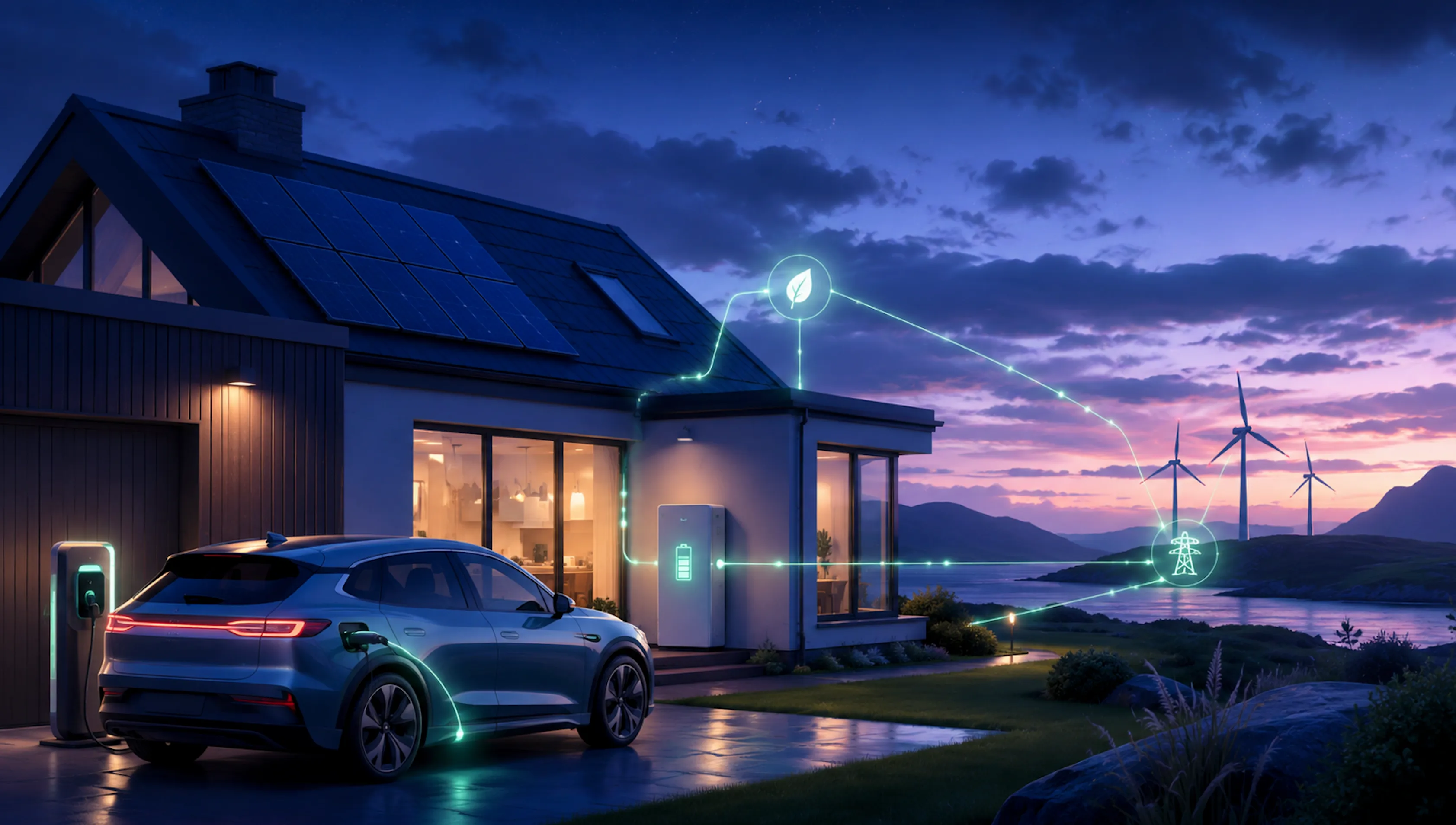
When Is the Best Time to Charge Your EV or Home Battery in Scotland?
The greenest and cheapest time to charge an EV or home battery in Scotland is usually overnight. See live Scottish grid carbon intensity and learn why cheapest isn't always cleanest.
JME Green Energy
JME Green Energy Team
Plug in overnight. That's the short answer, and for most in Scotland it's the right one, somewhere between 11pm and 6am, when half the country's asleep and the wind turbines are still spinning away. Demand drops off a cliff, so the grid gets cheaper and it gets cleaner.
Here's the thing though. "Usually" isn't "always". A still, cold night is a different beast to a blowy one, and the difference in how green your charge actually is can be huge. The live data below shows you exactly how clean Scotland's grid is right this minute.
Live carbon intensity for the South Scotland region (SP Distribution — the Central Belt), updated every half hour from official National Grid / NESO data.
Right now in South Scotland
It's a good time to charge an EV or a home battery from the grid right now. Renewables are supplying 74% of South Scotland's electricity (wind alone: 74%), with 100% low-carbon in total.
That's 18 points more renewable than the GB grid right now (55.9% renewable across GB).
Greenest hour in the next 48 hours
Today 19:30–20:30
Forecast at about 83% renewable and about as clean as the grid gets. Good window to charge the car or fill the battery.
Next 48 hours (every 2 hours)
| When (UK) | Level | Renewables | Wind |
|---|---|---|---|
| Today 02:00 | very low | 73.7% | 73.7% |
| Today 04:00 | very low | 71.9% | 71.9% |
| Today 06:00 | very low | 76.2% | 76.2% |
| Today 08:00 | very low | 74.4% | 74.4% |
| Today 10:00 | very low | 76.5% | 76.5% |
| Today 12:00 | very low | 77.4% | 77.4% |
| Today 14:00 | very low | 78.7% | 78.7% |
| Today 16:00 | very low | 79.9% | 79.9% |
| Today 18:00 | very low | 82.2% | 82.2% |
| Today 20:00 | very low | 82.7% | 82.7% |
| Today 22:00 | very low | 82% | 82% |
| Tomorrow 00:00 | very low | 79.8% | 79.8% |
| Tomorrow 02:00 | very low | 79.4% | 79.4% |
| Tomorrow 04:00 | very low | 77.3% | 77.3% |
| Tomorrow 06:00 | very low | 78.1% | 78.1% |
| Tomorrow 08:00 | very low | 77% | 77% |
| Tomorrow 10:00 | very low | 75% | 75% |
| Tomorrow 12:00 | very low | 75.9% | 75.9% |
| Tomorrow 14:00 | very low | 75.5% | 75.5% |
| Tomorrow 16:00 | very low | 70% | 70% |
| Tomorrow 18:00 | very low | 70.2% | 70.2% |
| Tomorrow 20:00 | very low | 72.1% | 72.1% |
| Tomorrow 22:00 | very low | 74.1% | 74.1% |
| Fri 00:00 | very low | 75.1% | 75.1% |
Last refreshed: 21 Oct 2026, 02:05. Live data from the official National Grid / NESO carbon intensity service. Figures are gCO₂ per kWh of electricity.
⚡ Key Takeaways
- Charge overnight, somewhere in the 11pm to 6am stretch. That's when demand's lowest and the wind's usually still going, so it's about as cheap and as clean as you'll ever get it.
- Keep the big charges out of the 4-7pm weekday peak. Everybody's home, the gas plants come on to cope, the price climbs and the carbon climbs with it.
- Scotland's grid is one of the greenest in Britain, 73% renewables in 2024.
- Cheap isn't the same as clean. A fixed off-peak window is cheap because hardly anyone's awake to use the power, which has nothing to do with whether it's a blowy night or a dead-calm one.
- Round Stirling you're on the 'South Scotland' region, and it usually runs cleaner than the UK average anyway.
When is the best time to charge an EV or home battery in Scotland?
Overnight, between about 11pm and 6am. We've said it already but it's worth saying properly: this is the window where everyone else has stopped using power and the turbines haven't, so there's loads of cheap, low-carbon electricity sloshing around with nobody wanting it.
Best thing about it is you barely have to think. Smart overnight tariff, plug the car in before bed, and the charger does the rest while you're asleep, slotting the work into the cheapest half-hours on its own. You wake up to a full battery charged on the cleanest power of the day.
The only spanner in the works is the weather. Wind is what makes Scottish nights so green, and on a dead-calm winter night the turbines aren't turning, so even though your tariff still says "cheap" the grid behind it is leaning a lot harder on gas. The price doesn't change. What's actually coming down the wire does. Which is the whole reason that live readout sits at the top of this page instead of us just telling you "charge at night" and leaving it there.
The grid's at its dirtiest around teatime
Think about your own house at half five on a Tuesday. Everyone's back from work and school, the oven's on, the kettle's going, somebody's stuck the heating up, the telly's on in the other room. Now multiply that by every house in the country doing the exact same thing at the exact same time. That's the 4pm to 7pm weekday peak, and it's the worst time you could possibly charge.
The grid can't run a whole nation's tea-time off wind alone, so it fires up gas power stations to plug the gap. Carbon intensity shoots up. And if you're on a tariff that tracks the live price, your costs go up right alongside it, so you get strung twice.
So don't. Don't lump a big EV charge or a battery top-up into that window if you can help it. Push it to the overnight slot instead, or better still, run the whole house off a battery you filled earlier while everyone else is scrapping over the dear, dirty stuff. You charge cleaner, you charge cheaper, and you take a bit of weight off the grid right when it's struggling for it.
Why is Scotland's electricity greener than the rest of the UK?
Wind, basically. We're stuck out on the blowy edge of Europe, so we've ended up with thousands of turbines on the hills and parked off the coast, and a grid that's about the cleanest in Britain because of it. Most of the year there's a big wind-heavy floor sitting under everything we use.
And it's not abstract national-grid stuff happening somewhere else. A fair bit of it's nearly on your doorstep. Whitelee, up on Eaglesham Moor just south of Glasgow, is the biggest onshore wind farm in the UK, you'll have driven past it on the M77 a hundred times without clocking how many turbines are sat up there. Then there's the offshore lot, Seagreen off the Angus coast, Moray East and West stuck out in the Moray Firth, Neart na Gaoithe down off Fife. None of that's happening in some far-off place. It's turbines you could drive to on a wet Sunday, feeding the same wires your house pulls off of a night.
So when you plug your EV in on a blowy one, it really is running on about the lowest-carbon power anywhere in the country. Not a feel-good line either. It's a number, and you can watch it move on the readout up the top.
It's not a given, mind. The wind drops and the gap between us and the rest of the UK shuts right up, and it shifts by the hour, sometimes quicker. So no rule of thumb survives it. Look at the live figure rather than trusting any of this to hold on a dead-calm night.
Is the cheapest time to charge also the greenest?
Mostly, aye. The two line up more often than not, and there's a proper reason for it, not just luck. Electricity gets priced off whatever the dearest generator running at that moment is, and that's nearly always gas. So when the wind's up and demand's down, your classic blowy night, your lazy Sunday, gas gets shoved out the picture and both the price and the carbon drop away. Cheap usually does mean clean.
The thing that breaks it is your tariff. They don't all work the same way, and that's the bit worth getting your head round.
Why a fixed off-peak window isn't always low-carbon
Take something like Economy 7, or the guaranteed cheap block on Intelligent Octopus Go, say 11:30pm to 5:30am, same every single night. That's cheap because hardly anyone's awake to use power then. Nothing to do with the weather. So on a flat, freezing January night with not a breath of wind, that window is STILL dirt cheap on your bill while the grid behind it is quietly burning gas to keep going.
Now compare that to Agile Octopus, which moves with the live wholesale price every half hour. That one's a much better stand-in for "green", because its cheapest slots genuinely tend to land when the wind's howling and demand's flat. Closer. Not perfect, mind, nuclear and the power we import down the interconnectors muck with the carbon without always shifting the price to match.
So here's where it leaves you. Your tariff is telling you when electricity is cheap to buy. It is not telling you what that electricity is made of. Those two things rhyme most of the time but they're not the same question, and the only way to actually answer the second one is to look at live grid data, the readout up the top of the page.
Charging your EV on the cleanest power
You already know the answer to this one because we've hammered it half a dozen times: overnight, smart charger, let it schedule itself, stop reading. The numbers back it up too, a bog-standard 7kW home charger puts back about 7kWh an hour, so even a proper 40kWh top-up is done in roughly six hours. You've got all night. It fits with room to spare.
The one bit nobody really tells you about is the daytime charge. Say you're working from home and the car's sat on the drive needing juice by teatime, you can't just wait for the cheap overnight slot.
This is the situation where it actually pays to glance at that live readout before you plug in. A windy Tuesday afternoon can be every bit as clean as 3am. A grey, still one is a different story. Same time of day, completely different carbon depending on what the weather's doing, and the only way to know which one you've landed is to look. And whatever else you do, keep the big charges out of that 4-7pm peak. That's the one rule worth actually remembering.
How should I time my home battery in Scotland?
Same trick as the car, basically. Fill the battery up overnight when power's cheap and clean, then live off that stored energy right through the dear, dirty 4-7pm peak instead of buying from the grid when it's at its worst.
This is what we call load shifting. You're not using any less electricity over the day, you're just being clever about when you pull it from the grid. Buy when it's cheap and green, sit out the bit when it's expensive and gassy. That's the whole game.
Add solar into the setup and the order of things starts to matter. Use what your panels are making there and then, bank whatever's spare in the battery for later, and let that get you across the evening hump. Set up properly, that's a house barely touching the grid during the priciest hours of the day.
And here's the part people forget, this isn't just about your bill. Every unit you shift off the gassy evening peak and onto the clean overnight grid is a unit of carbon you've quietly knocked off your house. The battery's saving you money and lowering your footprint at the same time, without you lifting a finger once it's set up.
Why your bit of Scotland matters
More than you'd think, aye. The grid gets carved up into regions, and if you're round Stirling or anywhere in central Scotland you're sitting in the one they've called "South Scotland", the SP Distribution patch. Daft name, because it's not really the south at all. It stretches right up through the middle, takes in Stirling and all the FK postcodes around it. Don't let the label throw you.
The bit that matters: that region usually runs well under the GB-average carbon intensity. And nearly every "when should I charge" article you'll read online just quotes that one national average and leaves it at that, which actually sells your local grid short, because the number gets dragged up by parts of the country with a lot less wind than we've got.
That's the whole reason we set the readout at the top of this page to South Scotland specifically. It's showing you the electricity your house is genuinely pulling on, not some UK-wide figure that's half made up of places nowhere near as breezy as central Scotland.
Thinking about an EV charger, battery, or solar in central Scotland?
JME Green Energy is a Stirling-based MCS-certified installer of solar, battery storage and EV chargers across central Scotland. We'll help you make the most of cheap, low-carbon overnight power.
Get in touchFrequently Asked Questions
Common questions about charging an EV or home battery in Scotland.
Related Articles
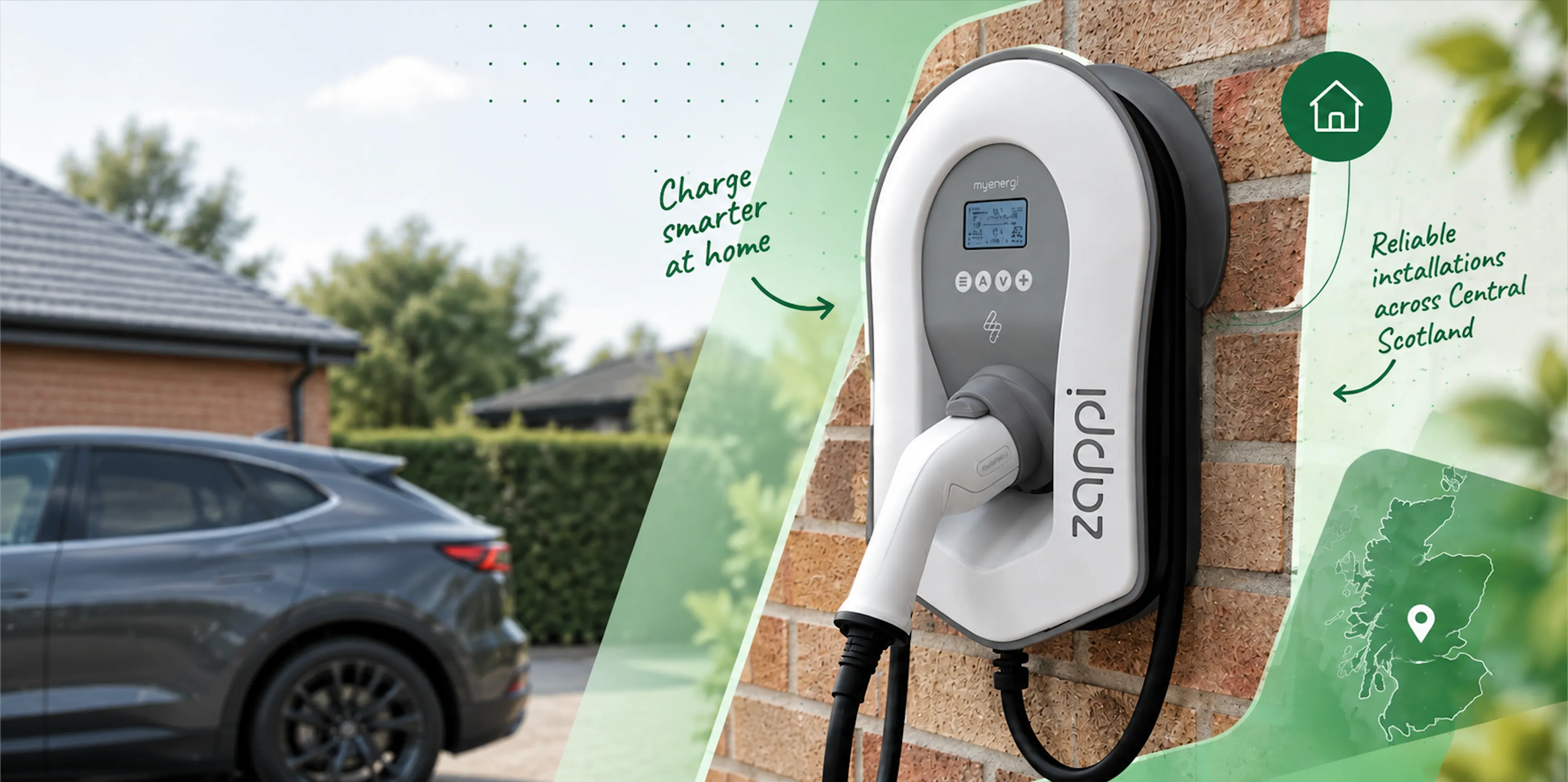
What Do You Need for an EV Charger at Home in Scotland?
Worried your fuse board or electricity supply won't cope with an EV charger? JME explains what we check, what might need...
Everything You Need to Know About Charging Your EV at Home
Ready to park up and plug in at home? Here’s a roundup of the most frequently asked questions about home EV charging.
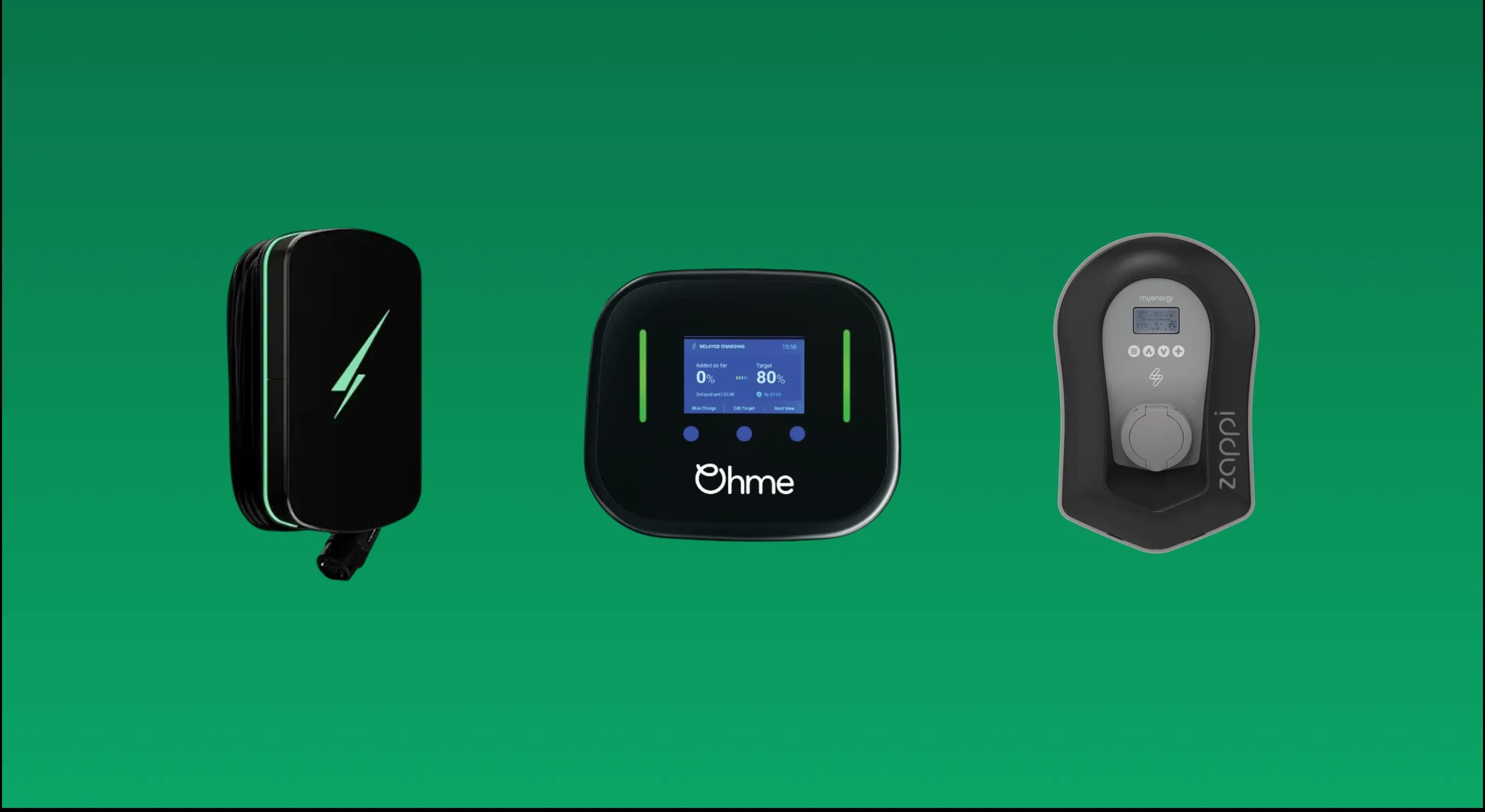
Zappi vs Hypervolt vs Ohme. Searching for an EV charger in Scotland? Let's see which one suits you best.
We install all three — here's our honest verdict. Which EV charger wins for solar homes, Octopus tariffs and Scottish we...