What Do You Need for an EV Charger at Home in Scotland?
Worried your fuse board or electricity supply won't cope with an EV charger? JME explains what we check, what might need changing and what it costs.
JME Green Energy
JME Green Energy Team
An old fuse board doesn't automatically mean you need a new one to get an EV charger fitted. We hear that worry a lot, usually from someone who's looking at an electric car and wondering how much work the house will need first.
What we need to look at is fairly ordinary stuff. Where you park, where the electricity comes into the house, what else runs off it, and how we're getting a cable out to the car. Some houses need a bit of extra work. We can explain that once we've seen what you've got.
We're based in Dunblane and fit chargers across Stirling, Falkirk, Clackmannanshire and the wider Central Belt. This is what we'd go through with you before an installation.
Start with where you park
A driveway or garage makes things easier. The car needs to sit somewhere you can get the charging cable to it safely, without crossing a public pavement or somebody else's space.
If you park on the street, speak to your council before buying a charger. A cable mat doesn't give you permission to run a lead across the pavement. Cross-pavement charging needs an agreed arrangement with the local authority, and what's available will depend on where you live. Transport Scotland is working with councils on this.
Flats and shared parking need a closer look too. Having an allocated bay is a start, but we still need to work out whose land the cable crosses and where the power will come from. If you rent, speak to your landlord. If there's a factor or shared ownership involved, get the permissions sorted before booking the work.
About that fuse board
You might call it a fuse box. We tend to call it a consumer unit. Either way, a full or older board doesn't, on its own, tell us you need to replace the whole thing.
The charger needs its own circuit and suitable electrical protection. If your existing board can accommodate that safely, we can use it. If it can't, one option is a small separate consumer unit for the charger, usually near the meter. That can let us leave the house board in place.
For reference, our allowance for that separate board is £275 plus VAT. It's something to check before agreeing to a much bigger job.
There are houses where the existing installation does need attention. We can't promise to leave everything alone without inspecting it, and we wouldn't want to. But if we recommend work on your fuse board, we should be able to tell you what needs doing and why.
The main fuse is a separate thing
The main supply fuse sits where the electricity comes into the property, before your house fuse board. It's sealed and belongs to the network operator, so leave that one alone.
A typical 7kW home charger draws around 32 amps. Your shower, cooker and other electrical appliances need their share as well. That's why we check the supply and the household demand, especially if you've got an older 60 amp supply or a heat pump.
If supply work is needed, we deal with the network operator as part of the installation process. That's SP Energy Networks across Central and Southern Scotland, or SSEN further north. They're the people responsible for the local electricity network; your bill might come from Octopus or British Gas.
Some network work is free, but we'd confirm what applies to your property before promising that. SP Energy Networks' EV guidance says some work is carried out without charge and other work needs a quotation.
You might also hear us mention a “looped supply”. That means your home shares part of its incoming supply with a neighbour. The network operator may need to separate those supplies before the charger goes in. It can affect the timing, so we'd rather find it during the survey than when you're expecting us to fit the charger.
Getting the cable to the car
This can make more difference to the price than people expect. A charger on the wall beside the meter is a different job from one at a detached garage at the bottom of the garden.
Our standard installation allowance includes up to six metres of cable and one external wall drill. Extra cable is £12 per metre plus VAT. Longer routes still need checking for cable size, access and how we can fit it neatly.
Then there's the house itself. If you're in an older stone property in Dunblane, Bridge of Allan or Stirling, getting through the wall can take more work than it would on a newer house. We need to see the wall and the route before pricing it properly.
A cable crossing a driveway may need groundworks and suitable underground protection. Digging and putting the surface back are part of the job to agree in advance. Send us photos of the meter, fuse board and where you park, including the space between them. A close-up of the fuse board helps, but we need to see where the cable is going too.
Earth rods and the charger itself
Some customers have been told they'll need an earth rod in the garden. That depends on the supply, the charger and how the installation is designed.
You'll see “open-PEN protection” on charger specifications. It's protection against a particular fault in the incoming electricity supply that could make the car unsafe to touch while plugged in. Some chargers have it built in; others need separate equipment. We check that when choosing and installing the charger, so you don't need to work it out from a product listing.
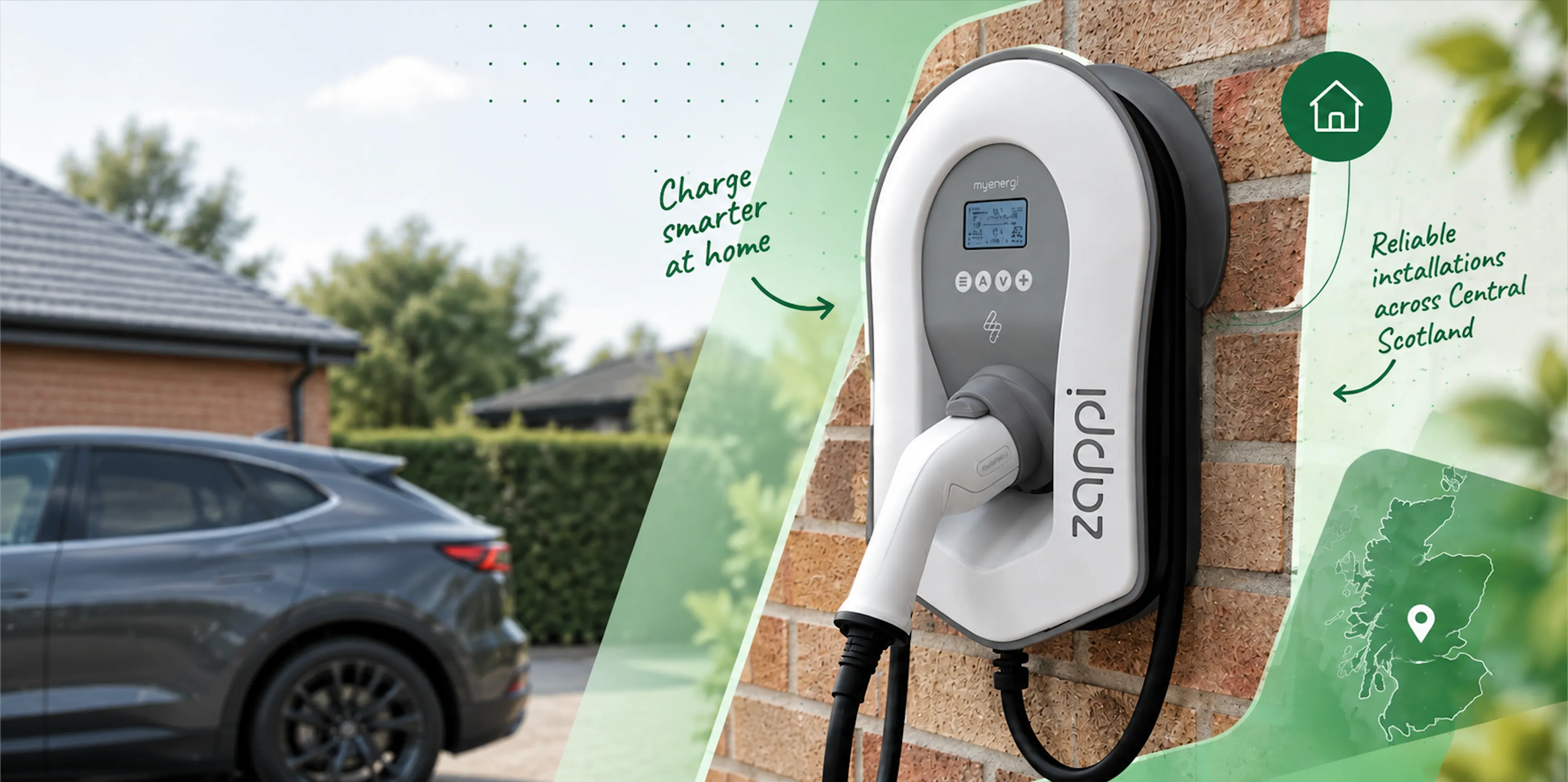
The more useful conversation for you is how you'll use it. Got solar panels? Tell us, because a charger that can use surplus solar generation, such as a myenergi Zappi, may suit your setup. Got a home battery as well? We need to take that into account when setting everything up.
If you're choosing around an overnight electricity tariff, we'll check that the charger and tariff work together. And if all you want is to plug in after work and have the car ready in the morning, say that. You don't have to pay for features you'll never use.
We've covered the options in more detail in our Zappi, Hypervolt and Ohme comparison.
What it costs
These are the allowances in our standard installation pricing. Your quote should show which ones apply to your house.
| Item | Price excluding VAT |
|---|---|
| Charger unit, depending on model | £365–£640 |
| Standard installation, testing and certification, including up to 6m of cable and one external wall drill | £475 |
| Separate charger consumer unit, if needed | £275 |
| Cable beyond the included 6m | £12 per metre |
With those charger prices, the unit and standard installation come to £840–£1,115 plus VAT, or £1,008–£1,338 including VAT. A separate board, a longer cable route or groundworks would add to that. We'd go through those costs with you before the work.
For the full picture on what an installation costs in Scotland, including the grants that stack here, see our EV charger installation cost guide.
A few other things we're asked
Home charging, sockets and permissions.
Electrical Safety First's home charging advice covers socket safety if you're currently using a three-pin lead.
If you're looking at your fuse board and still aren't sure, send us a message. You don't need to know the fuse rating or the name of the earthing system. A few photos and an idea of where you want to park will give us somewhere to start.
Related Articles
Everything You Need to Know About Charging Your EV at Home
Ready to park up and plug in at home? Here’s a roundup of the most frequently asked questions about home EV charging.

Zappi vs Hypervolt vs Ohme. Searching for an EV charger in Scotland? Let's see which one suits you best.
We install all three — here's our honest verdict. Which EV charger wins for solar homes, Octopus tariffs and Scottish we...
When Is the Best Time to Charge Your EV or Home Battery in Scotland?
The greenest and cheapest time to charge an EV or home battery in Scotland is usually overnight. See live Scottish grid ...